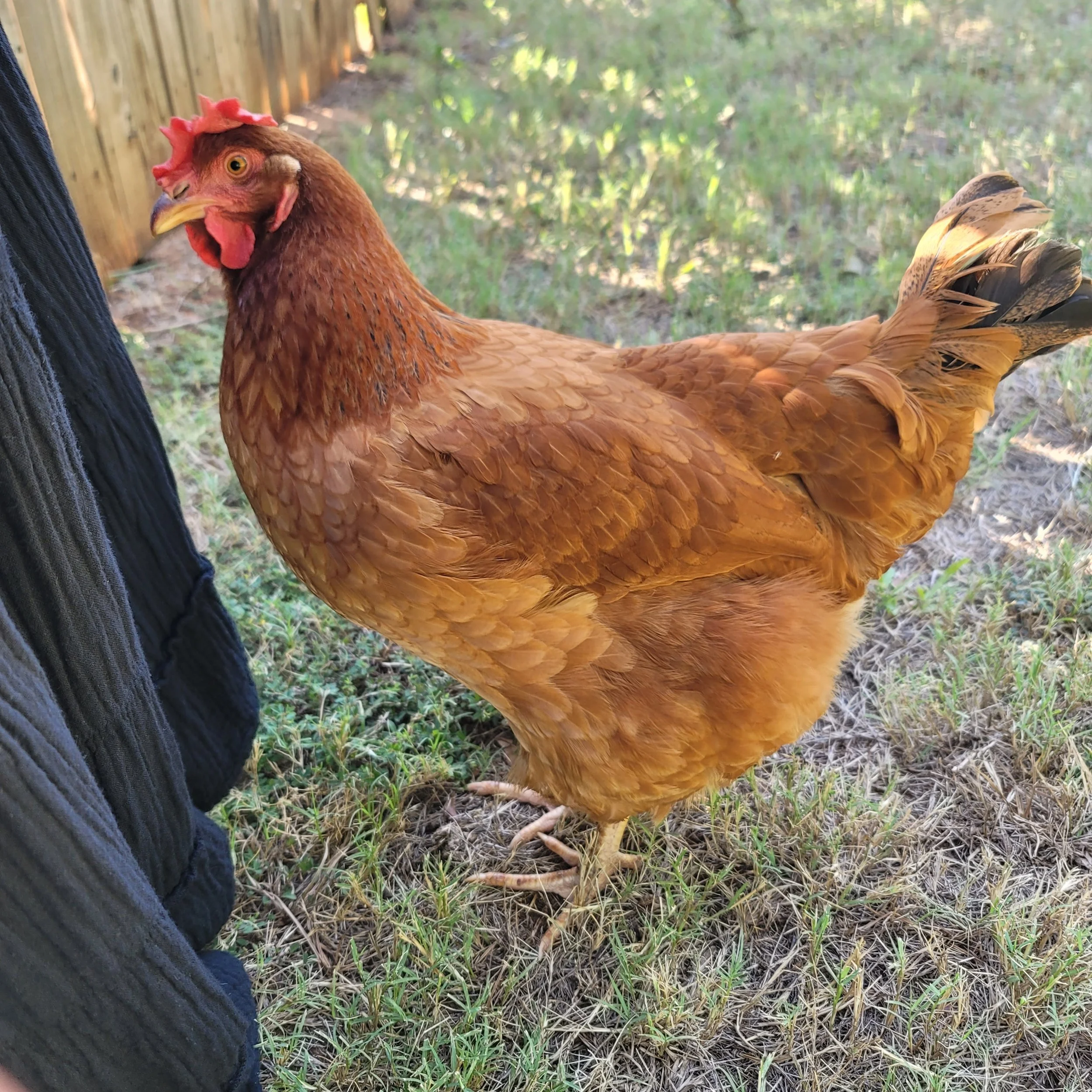
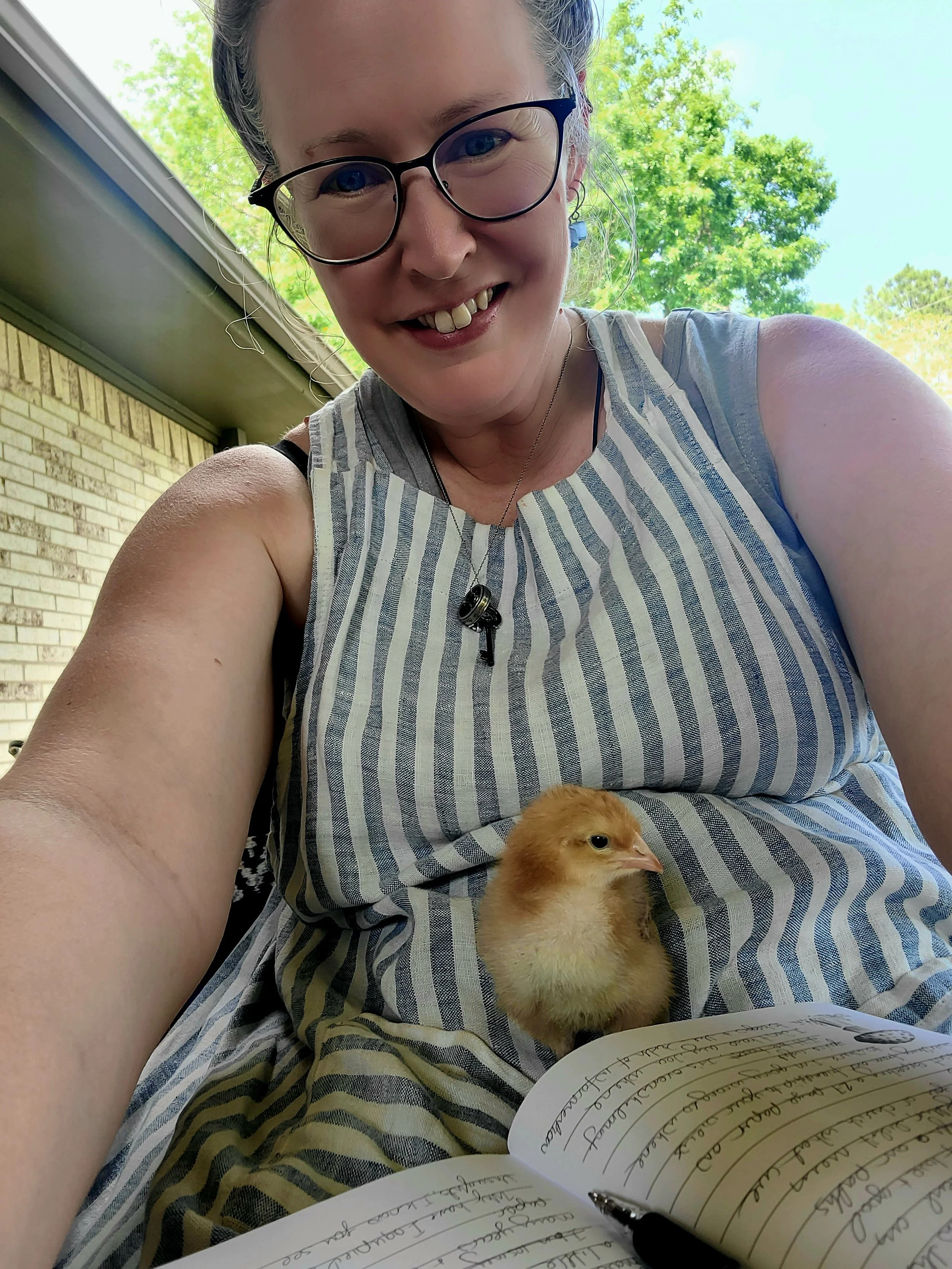
I prayed for Astrid’s death Saturday, Sunday, and Monday. She was going from bad to worse. Especially Monday night, when I finally moved her from her yard and coop to the garage so she wouldn’t die in the coop. (The idea of her lying there dead all night with her sisters disturbed me.) When I woke up the next morning and Astrid was still gasping, I cried. I cried because she was still suffering. I cried because now I had to do the hard thing, the hardest thing an animal owner, an animal lover, ever has to do. I—the one who raised her from a baby, loved her every moment of her life, the one she trusted—had to put her down. I had to take the hen who sat in my lap almost every day, who was offended if I was in the yard and she wasn’t allowed to be with me, who was such a gentle giant with the new babies, and end her life.
The grace I wanted was for her to go quietly into the night. I wanted the Lord to stop her breathing and stop her heart. I did not want to be the hand of providence, no matter how gentle I knew I would be. I didn’t want to be Astrid’s life and death. But she was still alive, and she was getting worse. She couldn’t walk. She wasn’t eating or drinking. She couldn’t protect herself. I had no idea what was wrong with her. She’d been sick for a while, and I’d tried many different things. The hard part about chickens, and all animals, is that they get sick and die. After Sigyn spent two weeks slowly dying in the laundry room in December 2025, I had decided I wasn’t going to do that again. I wasn’t going to take my hens from their home and from the outdoors. I have painfully wondered ever since she died if Sigyn would have lived if she had just been outside in her yard, if the sudden caging and non-chicken-ness contributed to either the lingering or the ultimate end. I think for some things it is important to separate a sick chicken from the flock, but I also think that sometimes they heal better when they’re in their own space. Have you ever tried getting well in a hospital? No. They send you home as soon as possible.
River: (to the cows, who stare at her with big eyes) Little soul, big world. Eat, sleep, and eat. Many souls.
Mal: Cattle on the ship three weeks, she don’t go near ‘em. Suddenly we’re on Jianying, and she’s got the driving need to commune with the beasts?
River: They weren’t cows inside. They were waiting to be, but they forgot. Now they see sky, and they remember what they are.
Mal: Is it bad that what she said made perfect sense to me?
-Firefly
So here I was on a Tuesday morning without the grace I wanted, without the grace I’d prayed for. I went about my morning chores, steeling myself for what I had to do, stomach churning, while I greeted the dawn, fed and watered the girls, talked with everyone, and attempted to do my Bible reading. That’s all hard to do when you’re begging for the death of a chicken, when you’re stalling, because you don’t want to do what you know you have to do. I brought Astrid outside for the last time, took her from the kennel, held her in my lap, and gave her a large dose of a sedative. None of that was peaceful or nice. For a chicken on the brink of death, she put up a fight. Trying to talk to and secure a creature so you can kill it is terrible. But the Lord gave me resolve and strength. I wasn’t going to put her through what Frigg went through. I’d already decided that too. I wasn’t going to let one of my girls suffer overlong again because I didn’t have the courage and know-how to let her go. Not again.
I laid Astrid down and walked away. One of the other things I’d learned with Frigg is that watching the actual moment of death is something I don’t want to carry around in my head. I want to remember Astrid as the joy and gift she was, ridiculous and clingy, dramatic and opinionated, not convulsing. I prayed the sedative would work fast and went to talk to my living hens. Astrid flopped around. I moved her back to the little towel I’d nestled her into, talking quietly, praying she’d go. I turned away, back to the other girls. When I went back just moments later, she wasn’t on the towel, but she was dead.
Gently, crying, I put her in the hole in the garden I’d already dug. I had dug it on Monday, knowing I’d need it soon. I buried her in the flowerbed with Freya, Figg, Sigyn, and Norn, my dear, beloved Astrid. As I finished and went to clean up and be with my living hens, I felt at peace. I no longer had to worry about Astrid, trying this or that, obsessively watching her to see if she was better or worse. It was done. She’d been a great chicken, and I’d been blessed to have her. My life was fuller and richer for the two years she was mine. I felt at peace and even had a sense of joy. Joy that I get to have chickens even when it’s hard because they’re such delightful and silly creatures. Joy that of all the chickens in the world, the good Lord had given me Astrid, and yes, a certain sober joy that I’d had the courage and strength to put her down when it was time. Who better to do that, to make that choice and actually follow through on it than the person who loves her?
That was when I realized that my heavenly Father hadn’t given me the grace I wanted, but the grace I needed. I needed the grace to do the hard thing, to take full responsibility for the little chicken life I’d been given, to face the horror of death, and to follow through. That was the grace I needed, the grace that grows grit and love, not the grace that made things easy. Over in my homemaking group, inspired by Homemaker Chic, we’ve been talking about doing the hard things for a couple of years now. Doing the hard thing grows us and roots us in a way easy things can’t and won’t. It’s the whole idea of character-building that our dads were so keen on. We don’t build virtuous characters by having it easy. We grow them by doing the hard things. The easy thing would have been for Astrid to get miraculously well with no effort from me. The hard thing was wrestling with her being off for months and then taking a turn for the worse without any obvious signs of a problem, making decisions for her health and wellbeing that I was never sure were actually helping, and then finally, putting her down. That was hard. But my heavenly Father gave me grace each step of the way. He helped me see that all the hard things I was doing were ultimately expressions of love – a deep and true love for this creature I’d had since she hatched. I’d been her owner, mother hen, and friend for two years. That was a blessing, and the last way I could bless her was to end her struggles. This was the hard thing and the loving thing.
God gave me the grace I needed, not the grace I wanted, and I’m thankful He did. I’m thankful He grew me through Astrid’s life and death. I’m thankful I had her and was there to help her at the end. Chickens die. I can’t keep that from happening, and God has never promised sparrows won’t fall. But He has promised to turn evil to good, and that promise He kept fully and completely.
Oh, fearful saints, new courage take:
The clouds that you now dread
Are big with mercy and will break
In blessings on your head.
Judge not the Lord by feeble sense,
But trust him for his grace.
Behind a frowning providence,
He hides a smiling face.
-William Cowper-
'Cause what if Your blessings come through raindrops?
What if Your healing comes through tears?
What if a thousand sleepless nights are what it takes to know You're near?
And what if trials of this life are Your mercies in disguise?
-Laura Story-