Book Review: My Dear Hemlock
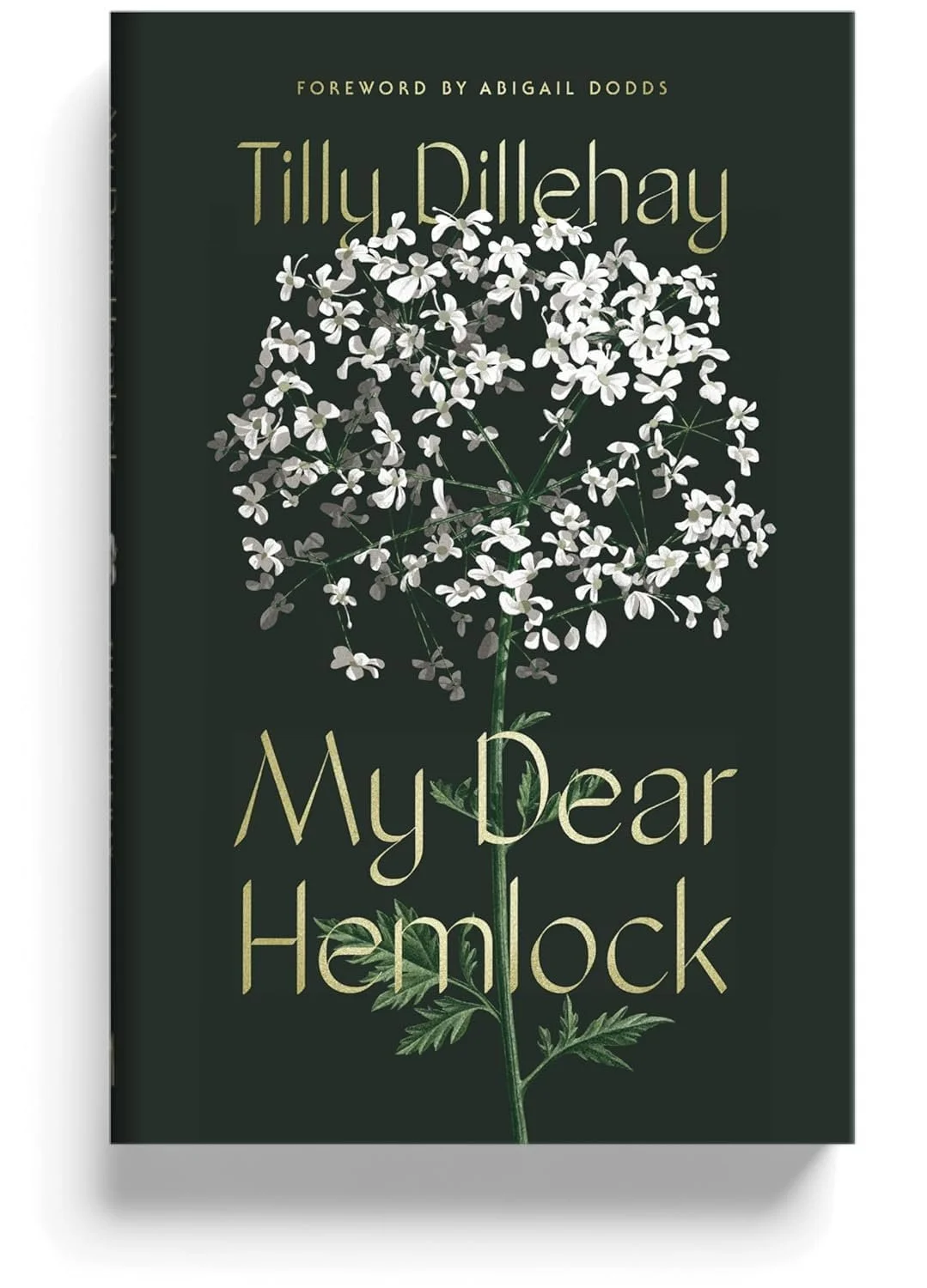
Abby and Sarah recently re-read The Screwtape Letters by C.S. Lewis together. After this, they read My Dear Hemlock by Tilly Dillehay together. This was Sarah’s first reading of it, and Abby’s second. Each wanted to write a review of it, and each appreciated the other’s review. Having read and discussed it while reading together, some of our thoughts overlap, but we tried to avoid being excessively repetitious.
Abby
I’ve read this book twice now, but my first time through, I didn’t really interact with the book. Especially with a theological book, if I’m not writing in the book or taking notes, I’m not joining in the conversation. I’m on the outside looking in.
This time, I was in.
This time, I walked away with a clenched gut and a profound sense of disturbance in my soul.
After reading it the first time, I had already decided to re-read it. But I wanted to read it after reading The Screwtape Letters, so I could see the comparison between the two more clearly. This did not play in My Dear Hemlock’s favor. I almost feel bad, like I’m being a bit mean, but Dillehay made the choice to write her work this way and open herself to this comparison. (1)
I’ve read The Screwtape Letters before. Every reading of it is like reading it for the first time. It is so dense, so convicting, and so full of joy that it is hard to hold onto. The reader walks away from it filled with a settled and deep sense of delight and wonder beyond himself. The book is arming and enriching. It produces a child-like love of the Lord, a tickled laugh at His goodness, and grander praise and worship of who He is. While it is a book you want to handle with soberness and care, it is good for the soul.
Having just finished that, I turned to My Dear Hemlock with three concerns:
The Screwtape Letters is 100% applicable to women. As I read it, I was intentionally checking to see if my particular temptations seemed unaddressed, necessitating a woman-centric version. I never once thought that it would be nice if Lewis had been talking to women specifically. Never once. I was far too busy dealing with the conviction Lewis was laying down. I’m concerned this book is unnecessary.
Lewis himself said that, because of the subject matter, it was important for this type of book to be short. I had a friend who had already found My Dear Hemlock discouraging, so I was concerned it is too long.
The Screwtape Letters is filled to the brim with hope and love and God’s “hedonistic” delight. I didn’t remember that same thing from my first read of this book. I didn’t remember walking away feeling armed and ready to go. I’m concerned this book isn’t encouraging.
I read this book over four days and walked away with an upset stomach and a sensation that I couldn’t breathe. I felt disturbed, like I had been forced to watch a torture scene in a movie—something I’m not likely to watch because I can't handle it. I felt like I’d just taken a long, soaking bath in sin. The book moves quickly from conviction to a study of sin. I felt incredibly ruffled. As I pondered on this, I realized that my deeper theological disturbance came from the processes of Sanctification. God doesn’t sit us down and just show us all our sin, for all our life, all at once or over the course of a few hours. (2) God is far more gentle, long-suffering, and merciful than this book is. He shows us peeks at ourselves—a few things to work on, then deeper layers, then deeper layers. He is kind. He is slow.
This book throws so many sins at the reader’s face and so specifically lists them that the only thing the reader can respond with is guilt, guilt, guilt, possibly guilt for sins I haven’t committed, and more guilt. Would you like a side-helping of guilt to go with your guilt? I felt like Christian from Pilgrim’s Progress, but instead of being given his armor, he was regiven his burden. My sins have all been covered, and the Lord is doing the work of sanctification, but now I’m a disturbed child floundering through page after page after page, crying, “Am I doing that?” Not as a point of conviction, as conviction and repentance are good, but forgetting what Christ won for me and taking on a huge helping of false guilt. Even the apostles, when addressing sin, don’t have chapter after chapter after chapter of specific sins specifically pointed out. They talk in generics and concisely, because otherwise we are in danger of planting heart-gardens of sin. It does not do to dwell on sin. It is damaging to our souls.
I am concerned that ultimately this is a massive book of gossip. One of the ways in which I saw this was the encouragement/almost command in the chapter “On Confession of Sin” that true confession includes confessing secret sins to people other than God. I can see times this may be necessary, but I can’t for the life of me find a Biblical command that requires repentance to include others whom I haven’t sinned against. I can see multiple circumstances where this could turn into gossip between saints and create unnecessary burdens for both the confessor and listener. We’re not Roman Catholics. We don’t need an extra intercessor between us and God to make our repentance true repentance.
The book also smacks of gossip because it feeds us sins we may not have considered. This is arming a Christian in all the wrong ways. At one point near the end, Madam Hoaxrot said, “She’ll be increasingly hard-hearted when she does encounter the ‘sin behind the suffering’ that you will encourage her to continually sniff out in other people’s lives.” I felt like this was exactly what this book did. It encouraged me to sniff out sin in my life and others, and it must have done the same for Dillehay when she was writing it. Again, I’m not opposed to the Lord’s sanctifying work; I’m opposed to spending my day staring at sin like I live under the law instead of under the covering of grace. The Screwtape Letters was convicting but convicting like a scalpel. This book was convicting like a bludgeon.
When I read this the first time, there were several points in the conversation between the two demons where I got turned around. I felt like I’d lost the rules of the trope and couldn’t quite follow who was the Enemy and who was the real enemy. I figured it was a me problem. Maybe I got interrupted or just hadn’t followed the flow of thought properly. In The Screwtape Letters, Lewis often has the demons talk about how much they don’t like or understand God, especially in how God deals with us. It is all very wink-wink, nod-nod. It always led to praise on the part of the reader and sometimes holy, joyous giggling. My Dear Hemlock failed to capture the joke. Instead, it disturbingly paints God as a bully who lies, cheats, and steals. It questions God with real questions without providing the answers. In a best-case scenario, you will have a reader like me who simply feels confused, like they tripped over the sidewalk. Worst-case scenario, a young or more naive believer might find themselves wrestling with their faith. When you start to see this, it becomes harder and harder to read, because these are not thoughts you want in your head. It is hard enough to hold onto God’s goodness without this. I found myself repeating the 2nd London Baptist Confession of Faith to myself: “The Lord our God is...most loving, gracious, merciful, long-suffering, abundant in goodness and truth, forgiving iniquity, transgression, and sin.”
Lastly, and very personally, the chapter on the pastor’s wife made my skin crawl. I shudder to think anyone has this perspective of envy and adulation towards me. The pastor’s wife was presented as such a cliche—beautiful and spiritual and perfect. Instead of having the demons address a real woman, they addressed a caricature that actual pastors’ wives never measure up to. I would hate for someone to read this chapter and think that I’m supposed to be the woman presented there or that they ought to admire their pastor’s wife in the fawning manner depicted. It was just creepy.
Was there any good in this book? Yes. The book is insightful and convicting. The chapter “On Gardens and Babies” was wonderful. I wish the whole book had been written with the same tone. It was the closest chapter to actually capturing The Screwtape Letters’ joy and humor and hope.
I loved this:
She responds viscerally to any image of a physical environment that has been elevated. A photo of a beautiful woman, casually but impeccably dressed and sitting in a pristine bedroom, doesn’t incite simple lust in her, as it might in a man. It rather invites her to generate an entire story of a grand life, joyfully lived. She sees that image and thinks not just of pillows and sweaters and hardwood floors but of love and productivity and freedom. An image of a kitchen, large and perfectly appointed, evokes for her an entire world: friends, family, food, spiritual health, joy inexpressible.
If the book had had more of this and less very-specific-sins just held up repeatedly in my face, if it had had more beauty, it might have been something grand. Unfortunately, all three concerns I had upon entering the book were on point. The book is deeply discouraging. (The introduction is too little to hold onto for the rest of the book.(3)) The chapters are far too long, leaving too much room for specifics. The book is unnecessary. Lewis is enough for men and women.
If you are looking for conviction with hope, try The Ten Commandments by Thomas Watson, Order and Honor in the Household by Samuel D. Renihan, and Home-Making by J.R. Miller. They will give you enough to chew on for a lifetime without pushing you face-first into the mud and muck.
Now, excuse me while I go sing some rich hymns, read a good book for the sheer enjoyment of reading it, walk in my garden, notice flowers, butterflies, and the changing leaves, and play with my chickens before I start dinner, tidy the house, welcome my husband home, and try to divest myself of the seeds this book planted in my heart-garden.
(1) I wonder if it would not have been better for Dillehay to simply write a book about the particular sins women struggle with? She then could have built hope and help directly into the book, instead of requiring the reader to find all that on our own.
(2)This image keeps coming to mind: Morgoth punishes Húrin – Ted Nasmith
(3)The introduction gives instructions on not allowing this book to steal you away from grace and turn you into a navel-gazer, but it just wasn’t enough in the face of the book as a whole.
Order this HearthKeeper book here.
Sarah
I was recently incredibly blessed by a book that was recommended to me. It’s not often I find a book filled with so much Gospel joy, grace dripping from the pages. And in a hard season, it was exactly the gentle, motherly encouragement I needed to convict, but also comfort me. One caution the author offered particularly stuck with me…
“Spiritual counsel that has ‘empty calories’ or is devoid of rich, biblical doctrine cannot and will not satisfy a soul that was made to be satisfied only with an infinite God. Can you identify any spiritual ‘junk food’ that you’ve partaken of recently?” -Gloria Furman, Treasuring Christ When Your Hands Are Full
Indeed, I can. Some of the worst spiritual junk food I’ve read in my life was another recent read, My Dear Hemlock.
My Dear Hemlock is a modern rewriting of The Screwtape Letters by C.S. Lewis…although I cringe at naming them both in the same sentence. At best, Hemlock is a cheap imitation of the original, and at worst, it is a harmful, damaging disgrace that Lewis himself, I believe, would have strongly criticized. It may be unfair of me to compare the two, but the author, Tilly Dillehay, invites the comparison and its negative findings upon herself.
In trying to avoid being unfair and unbalanced in my review, I want to say up front that there were some good things in this book. A few passages I really enjoyed, an idea or two worth sitting on and engaging with on a deeper level, and some punchy quotes I saved. She writes with insight on the female tendency to bitterness, ingratitude, and approval-seeking. Her two passages on gratitude were fantastic, and I was particularly helped by some of her writing on the woman’s concern with “what people think” about her children. I am sure that this book has done some good to some readers. But I feel that would be in large part in spite of itself.
Where Screwtape leaves the reader feeling victorious, awakened, and thinking “I never thought of that quite that way,” Hemlock left me completely defeated, discouraged, and, to be frank, feeling quite dirty. My concerns were primarily two-fold. One, her unnecessarily detailed writing on sin. And two, how she writes about God.
Beginning with the sin… Virtually every chapter is steeped in sin. Sin, sin, sin. The more you read, the more the demons’ voices whisper sin, debauchery, and wretchedness into your mind. Far from feeling like it was uncovering secret sins in myself, I felt like it resurrected feelings of guilt for old, dealt-with sins that are covered in Christ. It planted dismay, fear, and even new sins. Where Lewis writes primarily in big-picture ideas and metaphysical terms, Dillehay is much more practical, nitty-gritty, and specific. This would often be a good thing, except, again, we are talking about sin. Lewis’s demons say, “get the patient to think in this manner, or create this habit of viewpoint.” Dillehay’s demons say, “plant this thought, and this lust, and this discontented grumble; have her meditate on this list of difficulties and discontentments,” and then she gives the full list.
In sharing some of my concerns with my husband, he said she seems to write “in instructive detail.” This exactly hit the nail on the head. When my father preached on sins of the mind and guarding our thought life, he often brought up the example of unhelpfully telling someone, “go sit in the corner and don’t think about a little white bear.” This seems to be exactly Dillehay’s method of sin-fighting.
And secondly, how Dillehay writes about God. This is more difficult to explain, but trying to sum it up quickly to start – it’s very confusing and murky; her meanings and intentions get lost, and you’re left squinting at it, saying, “what is she really trying to say here?” This may seem like a small concern. Except, again, we’re talking about GOD. And the author is attempting to speak truth about God through the lying mouths of demons. Both of these facts mean you must be very, very careful what and how you write…and even how you read it.
Lewis’s demons, to my memory (and I re-read Screwtape right before reading Hemlock and writing this review), never speak real lies or blasphemy about God. If they do, it is rare and carefully done enough that it never tripped my alarms. Dillehay’s demons do on multiple occasions, and in such ways that it made my skin crawl to read it. Where Screwtape says things along the lines of, “God is love, He actually loves the human vermin that we hate. We don’t understand why, what He means by it, and what He must be up to,” Hoaxrot (the demon voice of Hemlock) says things much more along the lines of, “God hates them, doesn’t seek their good, and actually wants to hurt and destroy them.”
Examples:
They’ll deserve what they have coming when He destroys them with a look (after giving them the desire for the look in the first place). More of the same with Him. From the beginning He has done so: forever planting the desire for the impossible into the hearts of his creatures and then punishing us for wanting things.
He has invited her to forsake other things in order to one day ‘enter into the joy of her Master.’ Take care that she sees the barb in this promise (‘your MASTER’). He would master them, and they can never truly be one of the Fellowship, when He reserves the center spots of that Fellowship for His own self…The problem is that His joy, as He describes it, is entirely in Himself. She can have no part in it, not really.
The Enemy’s book repeatedly admits the impossible position human cubs are in from birth: ‘Folly is bound up in the heart of a child,’ says the proverb. In other words, the Enemy admits that He spits them out into the world with no sense at all and then punishes them for seeking the only end they are born capable of pursuing. If your patient can’t see the question in that statement, do help her find it…
If I squint hard enough, I can see the theological truths she’s trying to speak to, though veiled in lies, hatred, and villainy. In response to my criticism, I know the argument is, “Well, that’s the point. You’re reading demons. What else do you think they would say?” But to me, that’s not the point. The point is, “Let no corrupt communication proceed out of your mouth, but that which is good to use in edifying, that it may minister grace unto the hearers.” (Eph. 4.29). In reading Lewis’s demon-voice, I never felt like he was actually giving evil a voice. There’s no other way to read Dillehay.
Lewis took a step back from this kind of entrenchment into the diabolical voice. He wrote much more to mock the demons than to give them what amounts to a fair hearing. Lewis, in speaking for the demons, made them ridiculous, shamed them, exposed them. Dillehay, in speaking for the demons, made them fearsome, discouraging, and at points, almost believable…the only thing left shamed and exposed are the humans, both the fictional Patient, and the very real Reader. Screwtape is often full of dry wit. Hemlock is humorless, and where there are attempts at jokes, they fall far short in comparison to the muck and discomfort of the rest of it.
Other issues I had with this book included portraying some things as sin that I do not believe are, while portraying other things as good that I do not believe are (and neither of these being the case simply because of the demonic inversion). At points, there were even contradictions (harmless enjoyment isn’t sin, but social media is always sin; encouraging your husband in his prayer life is sin, but confronting another woman about her prayer life is not). It began feeling like what the author personally disapproves of is sin, and what she approves of is not.
If I had read this as a baby Christian, struggling with assurance and various doubts and questions, I would have been left completely unmoored. I want to say that this book could help some people. But all I can say is that if a woman has struggled with certain sins, this book would only serve to resurrect those sins or, at the very least, the feeling of guilt for those sins. And if a woman hasn’t struggled with certain sins, if she hasn’t noticed them or been confronted about them, I’m doubtful that even this book would help. Really, any woman seeking to be helped by a book like this is showing a tenderness of heart and conscience that makes her more likely to be harmed by it.
This book is a stumbling block between two covers. Be careful.
Much, if not all, of the good in this book was a simple repackaging of themes that were better done in The Screwtape Letters. (I don’t know what it is about the modern woman that is so incapable of making self-application from universal truths that we have to have a “women’s edition” of everything.) Some passages were so similar to Lewisian themes that it really did come across as shoddy fanfiction.
I think some of the issues with this book could have been resolved if it were maybe half as long. This would have forced the author to stop waxing eloquent and “instructive” about sins best left alluded to indirectly. Or not at all. But really, my honest opinion is that this book shouldn’t have been written in the first place. I believe Lewis would agree. In one of his prefaces to Screwtape, he wrote the following:
I was often asked or advised to add to the original ‘Screwtape Letters’, but for many years I felt not the least inclination to do it. Though I had never written anything more easily, I never wrote with less enjoyment. The ease came, no doubt, from the fact that the device of diabolical letters, once you have thought of it, exploits itself spontaneously, … It would run away with you for a thousand pages if you gave it its head.
But though it was easy to twist one’s mind into the diabolical attitude, it was not fun, or not for long. The strain produced a sort of spiritual cramp. The world into which I had to project myself while I spoke through Screwtape was all dust, grit, thirst and itch. Every trace of beauty, freshness and geniality had to be excluded. It almost smothered me before I was done. It would have smothered my readers if I had prolonged it.
To quote my cousin, if a book with as much joy and humor as Screwtape was such a burden to the author, “what darkness of mind must Hemlock have produced?” Or if it didn’t…maybe that’s even worse.
In her Acknowledgments, Dillehay wrote, “Thanks to Clive Staples; no one should attempt this sort of thing, but we just can’t help it.” To write such a mess as this book, and then arrogantly call herself “we” alongside Lewis was too much for me. But she’s right. No one should have attempted this sort of thing.

Thank you for the edits, and the thoughts, as always.