The Moon is Down and The Pearl by John Steinbeck

The Moon is Down
The main character in this book is an old man with bushy eyebrows and ear hair, but the heart of this story is the three women—Maid, Matron, Crone— and their three tools: scissors, a pot of boiling water, and ear hair trimmers. Set during WW2, The Moon is Down is about a town occupied by the Nazis who want their coal mine. It is short, entertaining, heart-wrenching, and beautiful.
It amazes me, as a writer, how much Steinbeck can pack into such a relatively small book. The rich descriptions, the fully fleshed-out characters, a moving plot that brought me to tears. But what I love most are his women. They’re mostly in the background, quiet (except for Annie), but they have incredible strength, fortitude, and love. It shines out. They really are an example, in the very form of the story, that women are the heart of the home. You never get a sense that these are caricatures of women. These are real women, living real lives, with their tools that help them do their work. It strengthened me to visit with them for a short time.
Side Note: If you are a busy mom, both of these books are short. The Moon is Down is 111 pages, and The Pearl is 90. They’re not difficult or complicated reads. They are beautifully written and rich in things to discuss and ponder on. They’re both great ways to feed your mind when you have little bandwidth.
The tools these women use to fight their own little wars against the invaders occupying their homes, streets, and town are normal, everyday tools. Molly is a homemaker—her husband works in the coal mines. She is armed with a pair of scissors from her mending basket. Annie is the mayor’s housekeeper and cook. She is armed with a pot of boiling water. Sarah, or Madame, is the mayor’s wife. She is armed with a pair of ear hair trimmers.
Maid, Matron, Crone.
Molly is such a Jael character. I love Jael’s story, and it shocks me that she’s so neglected. Here is a woman in her home, who uses that warmth and comfort and hospitality to lure in the enemy. She takes his life by driving a tent stake through his head as he’s sleeping, rescuing and avenging her people. How are we not naming more daughters Jael? Molly is Jael. She’s young, pretty, married, and her husband is executed by the Nazis. As the Nazis grow more and more isolated as occupiers, one of the officers seeks her out due to her warmth as a woman and the warmth of her home. The commanding officer’s view of fraternization was, “‘And the girl,’ Lanser continued, ‘the girl, Lieutenant, you may rape her, or protect her, or marry her—that is of no importance so long as you shoot her when it is ordered.’”
With the calm, deadly grace of Jael, to protect herself, her neighbors, and to avenge her husband, Molly welcomes in the Nazi officer while gripping her scissors like a knife!
Annie was easily my favorite. She is so prickly. She throws a pot of boiling water on a Nazi who dared to stand on her porch! How dare he! Annie is always a little angry, but that anger becomes her best weapon and makes her a hero.
“… Annie the red-nosed, the red-eyed, the angry. Annie was always a little angry and these soldiers, this occupation, did not improve her temper. Indeed, what for years had been considered simply a bad disposition was suddenly become a patriotic emotion. Annie had gained some little reputation as an exponent of liberty by throwing hot water on the soldiers. She would have thrown it on anyone who cluttered up her porch, but it just happened that she had become a heroine; and since anger had been the beginning of her success, Annie went on to new successes by whipping herself into increased and constant anger.”
At this point, she reminded me so much of Lobelia Sackville-Baggins. Nobody liked her until they needed her prickly, aggressive, anger to battle the occupiers. Annie is a wonderful example of courage, and also of taking care with our judgements. Annie probably wasn’t easy to live with before the war, but she was exactly what the town needed when the war came to them, a bit of courage, anger, and audacity.
Madame, or Sarah, was such a wonderful example of womanhood. She is the wife of the mayor. She wants her husband and her home to be presentable when the Nazis come because she knows that there is a strength in dignity, in forcing the enemy to respect you and facing your enemy with respect. She’s introduced in a humorous moment of trimming the hair out of her husband’s ears and attempting to tame his old man eyebrows, unsuccessfully. She worries about whether to offer the commander of the occupiers wine, whether to make him feel welcome or unwelcome. She is a woman in her home in a stressful situation that her husband is supposed to lead the entire town through, so she does what a woman does: she works to make sure things are dignified. Dignity is her shield. I love that she also goes to Molly later in the book when Molly’s husband is executed by the Nazis. The mayor sends her, and she goes, quickly. Madame is a bit zealous and argumentative, but at the end when she kisses her husband’s cheek, I wept. She stood stalwart beside him. She knew that at times her husband was her man and at other times he was the mayor. She knew where the lines were and respected them.
“From behind him Madame emerged, small and wrinkled and fierce. She considered that she had created this man out of whole cloth, had thought him up, and she was sure that she could do a better job if she had it to do again. Only once or twice in her life had she ever understood all of him, but the part of him which she knew, she knew intricately and well. No little appetite or pain, or carelessness or meanness in him escaped her; no thought or dream or longing in him ever reached her. And yet several times in her life she had seen the stars.”
I loved that none of these women were perfect, they seemed to have the best and worst of us wrapped up inside them. I love that all three of these women took on the Nazi occupation with courage, fortitude, grit, determination, grace, and the weapons they had at hand—scissors, a pot of boiling water, and ear hair trimmers. One made sure her man was ready to be the leader he had to be, one used her kitchen to inspire people to get angry and stand up, and one used her mending tools to strike back at the ones who took away the man she loved. Let this be a lesson to all, go carefully around a woman and her tools. Don’t touch those they love.
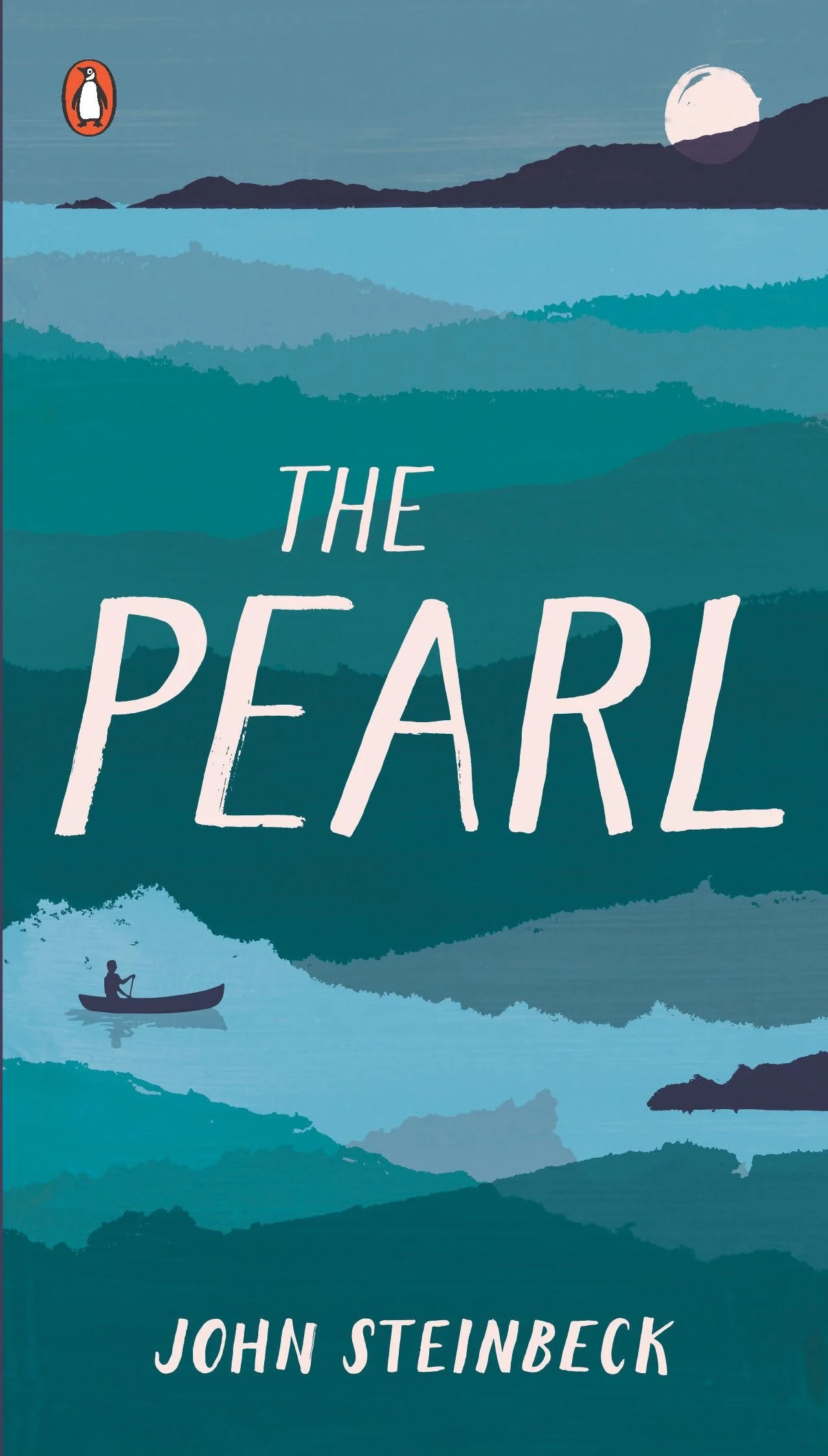
The Pearl
Again, I was just struck by all that was packed into this very short book. The sheer humanity of it all from family to extended family to neighbors to the village—homeless people, priest, doctor, jewelers—they all felt so alive. And the setting! The setting on the beach felt so vibrant and full.
Juana is the young wife of Kino and a new mother. Like The Moon is Down, she’s not the main character of the story, but she is the heart of the story. Her quiet presence, her love, loyalty, and courage pour out everywhere as she goes through the same rhythms of cooking in the morning, tending the baby, helping hunt pearls, cooking in the evening. I loved her singing the Family Song as a ward against evil, as a compliment to Kino’s singing, and as a help when he couldn’t sing it.
“Juana, in her woman’s soul, knew that the mountain would stand while the man broke himself; that the sea would surge while the man drowned in it. And yet it was this thing that made him a man, half insane and half god, and Juana had need of a man; she could not live without a man…Sometimes the quality of woman, the reason, the caution, the sense of preservation, could cut through Kino’s manness and save them all.”
As you move through this story, Juana has such a solid mother-feel. Secure, calm, gentle, protective, and wise. It was calming simply to read of her. Her main tool was her blanket, or shawl that she wears. She wraps her baby in it, wipes away blood, comforts, and conceals with it. Juana’s true strength shines at the end of the book. The tragedy they face doesn’t break her. She is still at Kino’s side. (The ending of this book still haunts me.)
Four women in two short books armed with everyday tools of their work, tending their people and their hearths with prudence, courage, and calm. They were a real blessing to me.

Click on the image to visit our community, our Knitting Circle.
Available on Amazon and directly from the publisher.

Thank you for the wonderful editing, Sarah!