The Benefit of Fussy Things
Fussy things? What are fussy things?
OneLook defines fussy as “demanding excessive attention or detail…having much unnecessary detail or decoration.”
Fussy things are high-maintenance things. They’re often hard things. But the question I want to wrestle with today is, are fussy things bad?
It is easy for us to count the cost of, say, decanting and decide that it costs too much. Who has time to take their pantry stock and put it in matching containers? Who cares? In a life-hack culture, we tend to get stuck on only two cost-benefit analyses: is it easy and fast? We can slip into this without even noticing. Our only measure becomes how quickly we can get something done in the least challenging manner.
Side Note: If you start thinking about the trickle-down effect of a career-focused culture, one of the things that must happen to support this is speed and ease. Nothing can be fussy because no one has time to be fussy. Anything that requires care, attention, and has a certain learning curve must face expulsion. A good example of this is textiles. Natural fibers take time and attention. They take care. They’re fussy. So, we either dry clean them (soak them in massive amounts of dangerous chemicals) or we wear plastic because it can simply be washed and go. No ironing or other work required. Who needs to learn to mend or sew with the excessive amounts of clothing we have just lying around?
We talk a lot about Homemaker Chic around here, and for good reason. They’re one of our biggest encouragements and influences. Having Shaye and Angela on in the background of my life has slowly led me to a shift in my perception of my work. They have an oft-repeated catchphrase: we do the hard things. Hard things are a regular topic. Sometimes it is encouragement to choose your hard because, either way, what you are facing across the barrel is going to be hard, so it can be hard now, or it can be hard later. (Like getting your tires changed.) The other way they use this is as an encouragement to not look for the easy way out, to keep engaging in things even when they are hard. Things like not using non-stick pans, knives that can’t go in the dishwasher, not using the microwave, working out, learning a new art or language, and making yourself read the hard books. They purposefully encourage homemakers to invest in things that take time and effort and will involve a certain level of failure. They encourage homemakers to pay a higher cost in their homes, not a lower one.
Why? What does it matter if we take every shortcut available and use quick and easy as our only measure of success?
We stop caring.
We have no skin in the game.
When our only goal is how quickly we can get something done and how easily we can do it, we stop caring about that thing. What does it matter if it is broken, destroyed, or trashed? When we haven’t poured any labor into something, we don’t care about what happens to it. And when we don’t care about what happens to it, we stop investing in it. It is like that rental house. The person who lives there doesn’t care. They don’t mow the lawn. They don’t beautify the property. It is an eyesore to the whole neighborhood. Or think about the difference between how you feel about the cucumber you harvested from your own garden vs. the one bought from the store. You probably don’t feel a thing about the one you bought at the store, but the one you harvested? You took a picture of it, crowed about it, and relished sharing it with family and friends. It matters to you because you put the hard work into growing it. This is true about raising chickens, too. Every egg matters because of the work you poured into that egg.
Quick and easy induces a certain level of subconscious franticness into our lives. We microwave because we don’t have time. We grab a new shirt at Target because we don’t have time. We don’t decant because we don’t have time. We don’t have time. We don’t have time. We don’t have time. It must be nice to have that life where they have time, we whisper hatefully to ourselves. The life-hack culture that would rather buy than build can’t hear the underlying mantra of a lack of time, but it drives them to always look for a shortcut. “Quick and easy” plays an ever-increasing song of franticness around us all day, every day.
This leads to atrophy. We are no longer sturdy homemakers. We are weak. Everything becomes anxiety-inducing and overwhelming. If we don’t work out, walking up the stairs makes us out of breath. We have no stamina. If we don’t eat healthy food, everything tastes weird and gross, except potato chips and soda. Storms come; we are bowed over. We, the ones who feed families, build shelters, and stand at the door of birth and death, can’t even face going to the grocery store. We want it to be easier and faster. We are incapable of dealing with problems, and everything is a problem because we aren’t sturdy. We haven’t put the work into growing our physical, mental, or emotional strength. Always avoiding anything fussy because it may take more time and require something of us—like our blood, sweat, and tears—makes us weak and ineffective.
The endgame of quick and easy is often a loss of beauty. Beauty is fussy. Beauty takes time. Beauty requires training of the eye, the heart, and the mind. Beauty has a high rate of failure. Beauty isn’t easy or quick. The world of home improvement, where everything is done in a matter of days, is fun but wildly unrealistic. I remember the moment I realized that the gardens I loved most were built through years and years’ worth of labor. Tasha Tudor didn’t get up one morning, just put a few daffodils in the ground, and voila! The Perfect English Cottage Garden. She worked her land her whole life, and so must I, spring after spring after spring. A well-written book isn’t written in six months, but over the course of years. When we look for the get-rich-quick route in our homemaking, beauty is the first thing we must get rid of because beauty is hard work.
A great example of all this is houseplants. Does it matter if you have faux ivy instead of real? Fake plants don’t have to be tended. They don’t have to be watered, checked on, or trained, and they don’t die. Isn’t it simply easier to have fake plants? Of course it is. Fake plants are much easier than real ones. But what do we lose when we use only fake plants? We lose the human, created-thing to created-thing relationship. We lose the air purification. We lose the tending of things that God created for us to tend. There is something about the way God made us that functions better around real plants, but it is intangible. It can’t be measured with a scientific machine, and it is not easy. It takes time to learn what will live around us with our lighting and what we seem to connect well enough with to keep alive.
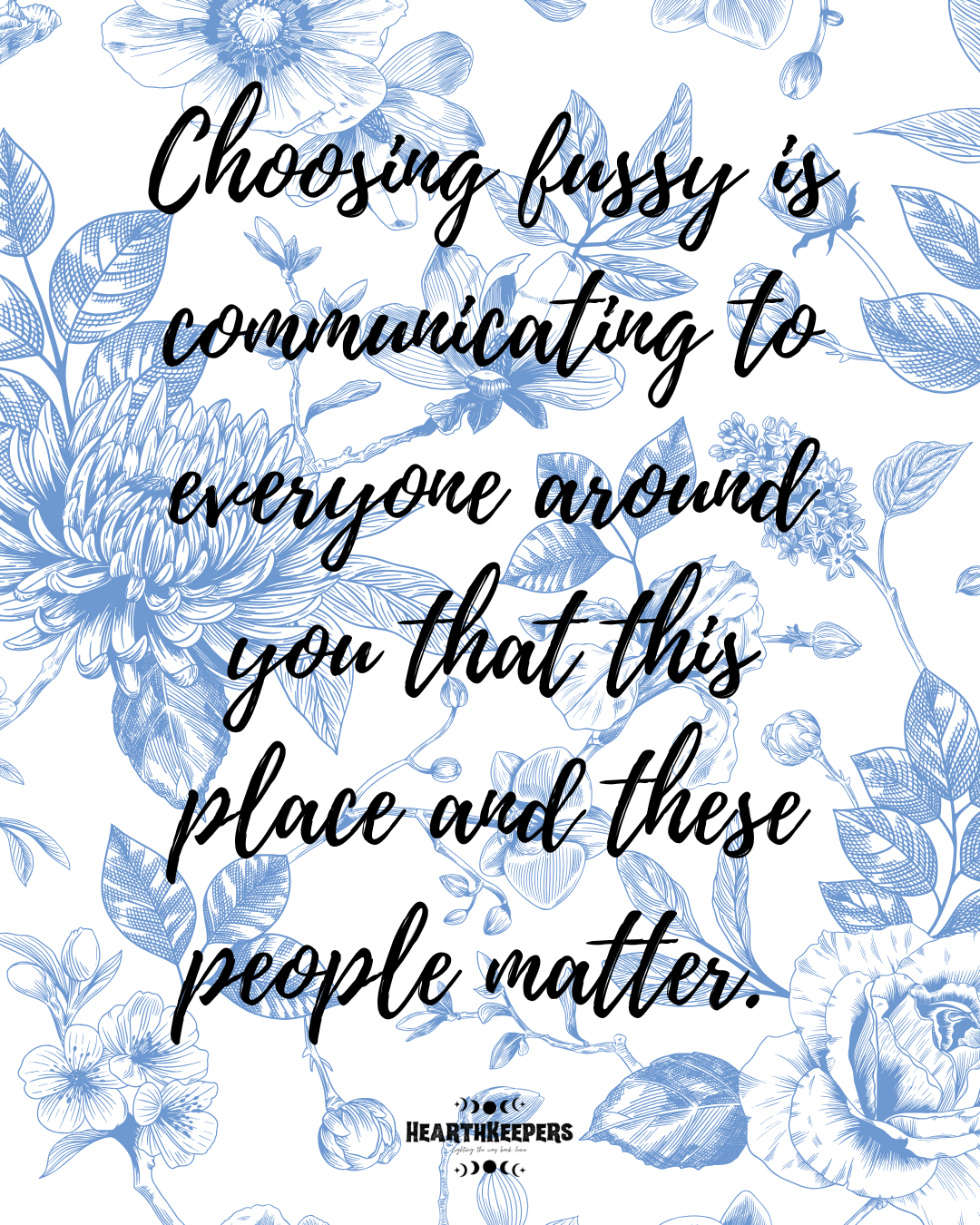
Choosing fussy is communicating to everyone around you that this place and these people matter. I have slowly realized this as I’ve been helping some other ladies update the look of our church building. Making it pretty and, honestly, a little more fussy (things that have to be fluffed, watered, and put in order) has made it matter. It has warmed up the building. It has helped more of us care. Almost every Sunday, someone asks for help making their Sunday school room or office more inviting. Picking a few things that require investments of time and energy has made the whole building a place to enjoy.
Now, before you homeschooling moms of littles and you ladies with chronic health issues find yourself in the middle of a panic attack because you simply can’t do one more thing, allow me to bring in some balance. The importance of fussy things, the connection that they give us with the world around us, doesn’t mean that we have to do EVERYTHING in as hard a manner as possible. We are finite beings. Choose your fussy.
After reading Laundry Love by Patric Richardson, I realized I could streamline my actual washing. This gave me the ability to wash, fold, and put away the laundry with more regularity and iron more regularly. I didn’t do my washing faster so that I could get out of the house. I did it so that I could be fussy in a particular area and not in another. I want to wash faster, but I also want a clothesline. There were things lost when we stopped using them, like the power of sunshine. I chose my fussy. I chose to iron, and I’m dreaming about hanging clothes out to dry. I have learned the value of bouquets of flowers in the house as often as I can, year-round, but I use fake pine and cedar in the winter because my husband is allergic to those. My gardens aren’t at the point yet where they can provide me with endless cut flowers. I buy bouquets in the meantime. I choose my fussy. I’m learning to thrift. Thrifting takes time. It is much easier to just order from Amazon or run into Target. Thrifting requires patience. I am choosing to retrain my fussy.
Sometimes fussiness and fussy things have to be set aside for a time. I love a well-decorated bed, something that invites tired people in to sleep. There was a point where, for two weeks, I didn’t make the bed this way. One week, I was gone for 4 days, all day, while my husband was home sick. I didn’t want him to have to mess with my pillows, throws, layers, and tray. I wanted him to rest. So I put all the bits and bobs of my bed in the guest room and only kept our pillows and blankets. The next week, I got sick, and so I did the same thing to save what little energy I had. I put the fussy things on hold for a time when they weren’t serving us.
We are finite creatures. We have limitations in our budgets, both monetary and energy. People are more important than things. These truths provide us with a central path to walk (“the golden mean”) when it comes to fussy things. You may be at a point where you can only pick one fussy thing. Life is full to the brim, so the only fussy thing you do in your home is have a pothos in a window. Much is required of you, so you decant and use a microwave. Your body is constantly at odds with your life, so you focus on handcrafts like knitting, embroidery, or crochet. That’s it. We choose our fussy.
Ladies, this is how it should be. We were never meant to do everything in this life. We do need to do the hard things. Don’t reject something because it will cost you. It might cost you more in the long run to take the quick and easy path. This is a great area we can trade in. I have eggs, and you know how to paint. Let’s trade. You’re good at thrifting, and I can grow flowers. Let’s trade. One woman’s fussy can often be swapped with another woman’s fussy.
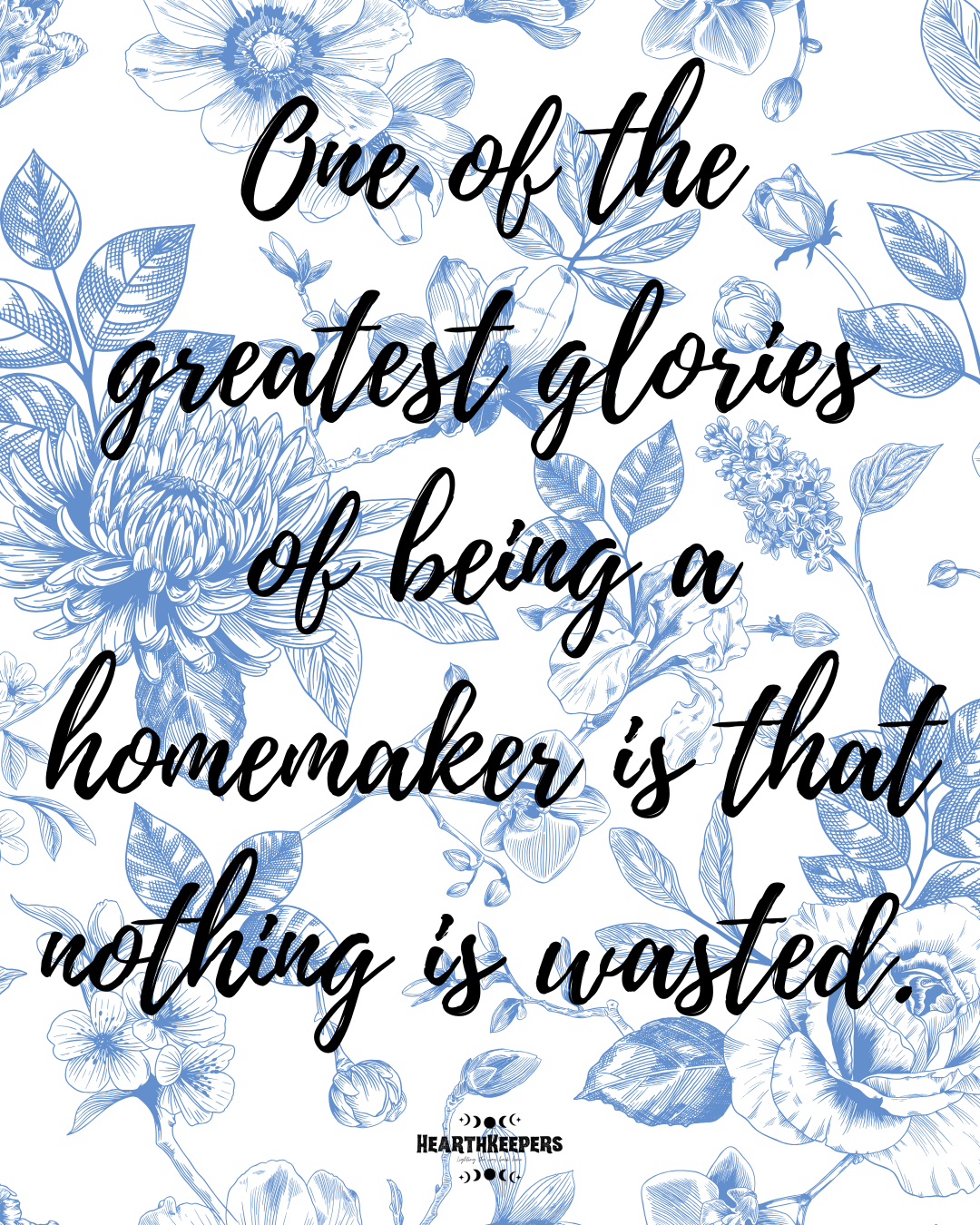
Finally, I would say an important part of this is being fussy with ourselves. It is important, ladies, to do the hard work of developing ourselves. Music, history, art, and education are important parts of our homemaking because they’re growing us. When we grow, our homemaking grows. One of the greatest glories of being a homemaker is that nothing is wasted. When you take ten minutes to sit with a cup of coffee or a glass of wine and read two paragraphs about a historical event, or study a piece of art, or really listen to a piece of music, you are homemaking, because it will spill out into the lives of those you tend. When we read Dickens, which stretches our minds, builds our vocabulary, and connects us with the past, we are homemaking. The broader we are, the more our hearths will hold, and we don’t get broader and sturdier by taking the fast and easy route.
Fussy things, things that require our labor, our minds, and our hearts end up mattering more to us than the things we picked up as we rushed through Hobby Lobby or Target. Let’s be homemakers who value hard things and sturdy bodies and minds. Let’s pass down this love to our daughters. When we find ourselves shirking from something because it seems overwhelming, let's lean into it as an opportunity to learn, practice, and serve our people. Let’s shift our thinking away from disposable to heritage, from buying to building. This will take time. It won’t happen overnight, but it is worth the hard work.

Click image to join our knitting circle and join the conversation.
Available on Amazon.
Thank you for your wonderful editing, Sarah!