We Need Other Homemakers by Amalia Clemen
Homemaking is truly women's oldest profession. But it’s a unique one. For the most part, it’s solitary - no co-workers, one homemaker per household. Besides that, there’s no definitive job description and no one “right” way to make a home. The infinite array of skills a woman can incorporate into homemaking means there will never be career mastery. It’s both art and science–there’s an undefineable art to creating a homey, hospitable atmosphere, while at the same time managing the science of budgets, paperwork, and schedules.
C.S. Lewis famously said, “The homemaker has the ultimate career. All other careers exist for one purpose only–and that is to support the ultimate career.” Homemaking– creating and running a home. Is it a profession superior to all others? A woman’s highest calling? Of course not; there is no such thing. Each of us has our own individual calling and whatever we’ve been called to do in this life, we should do it well. But, homemaking is foundational to society, and that’s what makes it the “ultimate” career. As goes the home, so goes the world.
No play can take place without actors on the stage–they’re essential. But how well would those actors function if no one was working behind the scenes opening the curtains, creating the sets, or giving the actors their cues? Not well at all. It’s the same way in a home. A 19th century journalist and actress named Kate Field (oddly enough, not a homemaker herself) summed it up well: “The world would go on the same if there were not a woman in the professions. It would come to speedy ruin if there were no women in the home.” As homemakers, we’re the ones who create the environment that gives our family a refuge from the outside world and the support for the responsibilities they have outside the home.
In spite of the individuality of the profession, women are social and crave community. We like to collect things: recipes, patterns, pretty things, letters, advice, memories. We also like to share. Whether face-to-face or via a screen, we look for companionship and ways to help each other. We want our friend to know how we got our baby to sleep through the night because it might work for her, too. We tell our friends about the new recipe we discovered. We crave each other’s wisdom and encouragement.
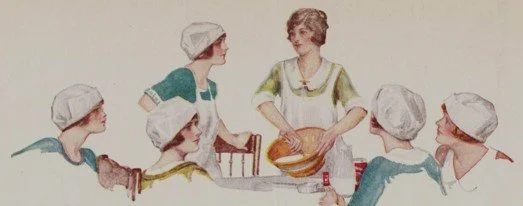
I grew up in a family where my mom was a full-time homemaker. I learned about keeping a home because it was part of life. She never gave me formal lessons in how to cut up a whole chicken or make a bed or can tomatoes. Working alongside her meant that I picked up many skills without realizing it.
Even so, I wasn’t an expert homemaker when I got married, not by any means.
-There was the time I learned what happens when you experiment and add too much shredded zucchini to a meatloaf. (Yes, it “stretches” the meat but it remains a gelatinous mass that never will solidify. Then you have nothing to offer your husband’s friend for dinner when he comes by to help with a plumbing project.)
-And that time I thought I’d speed up the process of canning pickles and put them in the pressure canner. (That one still boggles my mind. What was I thinking? I wound up with 7 quarts of dilled cucumber mush.)
-Or the one summer I didn’t manage my time well and took on way too much. An elderly lady friend ran her finger across my dusty furniture and suggested that she come over and clean for me, assuring me that her services would be affordable.
No matter how many skills we have, somehow it’s different when we’re actually setting up the systems and managing a home on our own. Homemaking changes constantly and as we go through various stages in family life, we need to develop different skills. A little guidance makes it all a little easier.
Women in the past were often separated by distance and didn’t have the ethereal technology that we do today. So when they couldn’t meet in person, they continued to collect and create, but luckily for us, they wrote and shared in a more lasting way. They wrote letters, books, and magazine articles. They saved sewing patterns and handwritten recipes and scribbled notes in book margins.
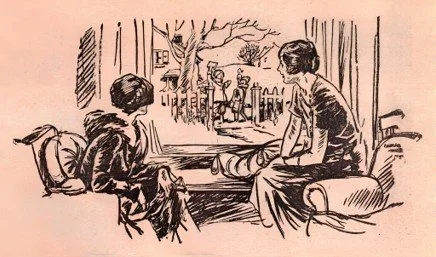
We’re the same at our core, but two things make our times a little different. First, the last one hundred years was a time of disruption to the generational system of passing on housewifery skills. With fewer homemakers working in the home, the sharing cycle has become more sporadic. Many homemakers today haven’t had mothers or grandmothers who were homemakers, so they’re learning everything on their own.
Second, modern society tends to segregate people by age and life stages–singles here, mothers of preschoolers in that corner, empty nesters over there, with everyone loyal to their generational label (which somehow, is always superior to every other generation). But that’s often like hoping a classroom of 10-year-old boys will learn life skills from each other. They’ll learn things, all right, but when they all have the same limited life experience, wisdom will be in short supply.
Ideally, we would seek out opportunities to live our lives alongside other homemakers–older than us to gain the wisdom they’ve learned, and younger than us to extend our support and to receive new energy. I believe it’s also worthwhile for us to look at the past for inspiration. And that is where my primary interest is and will make up much of my writing here on HearthKeepers.
Reading the writings of women of the past gives us a different perspective and draws us into a sort of camaraderie. None of it should be taken as gospel or divinely inspired any more than today’s writings are. They weren’t perfect and didn’t have life figured out any more than we do. But it’s often like getting some insight from an older female relative, or the one you never had.
Here’s some timeless encouragement for the homemaker, written in 1906:
“The strenuous efforts necessary to thoroughly cleanse and put our homes in order are strengthening in themselves, to both body and mind. There is joy in work, even in such work, in the ability to bring about our ends, to make home neat and comfortable and happy for those we love. We are truly co-workers with God, as we go forth into the fields and garden and place plants and seeds within the influence of the natural elements. He has given this earth land for its constant renewal, sure that in due time they will grow into flower and fruit and come into harvest.
And we are co-workers with God in influencing and training the souls for eternity that He has placed in our charge, and should be as sure that our efforts will be rewarded. ‘The heart of her husband does safely trust in her,’ and ‘her children shall arise and call her blessed,’ should be our constant encouragement as we cheerful, faithfully, and hopefully go our daily rounds, doing our best. The end of our humble efforts reaches far into the future, yet its fruit comes to us daily in signs of growth in love and character.”
When you seek out other homemakers of all ages, whether in real life or through the pages of history, you’ll be assured that your hard work is worth it. You’ll be encouraged by someone who’s already gone through it that the baby will eventually grow out of this stage. You’ll get some tested advice on prioritizing your time. And you’ll come to realize that we all, frequently, have no idea what to make for dinner tonight.

If you’d like to join our GroupMe chat, click the image above. We are largely a word-of-mouth community, so if you are enjoying our content, please share our articles and podcast episodes with fellow homemakers-maids, matrons, and crones. We would love to have you join the conversation.