Sometimes, you read a book, and it fills you with this weird evangelical zeal, and you become convinced that the shattered world will never be put back together unless and until all living humans read the book. -John Green
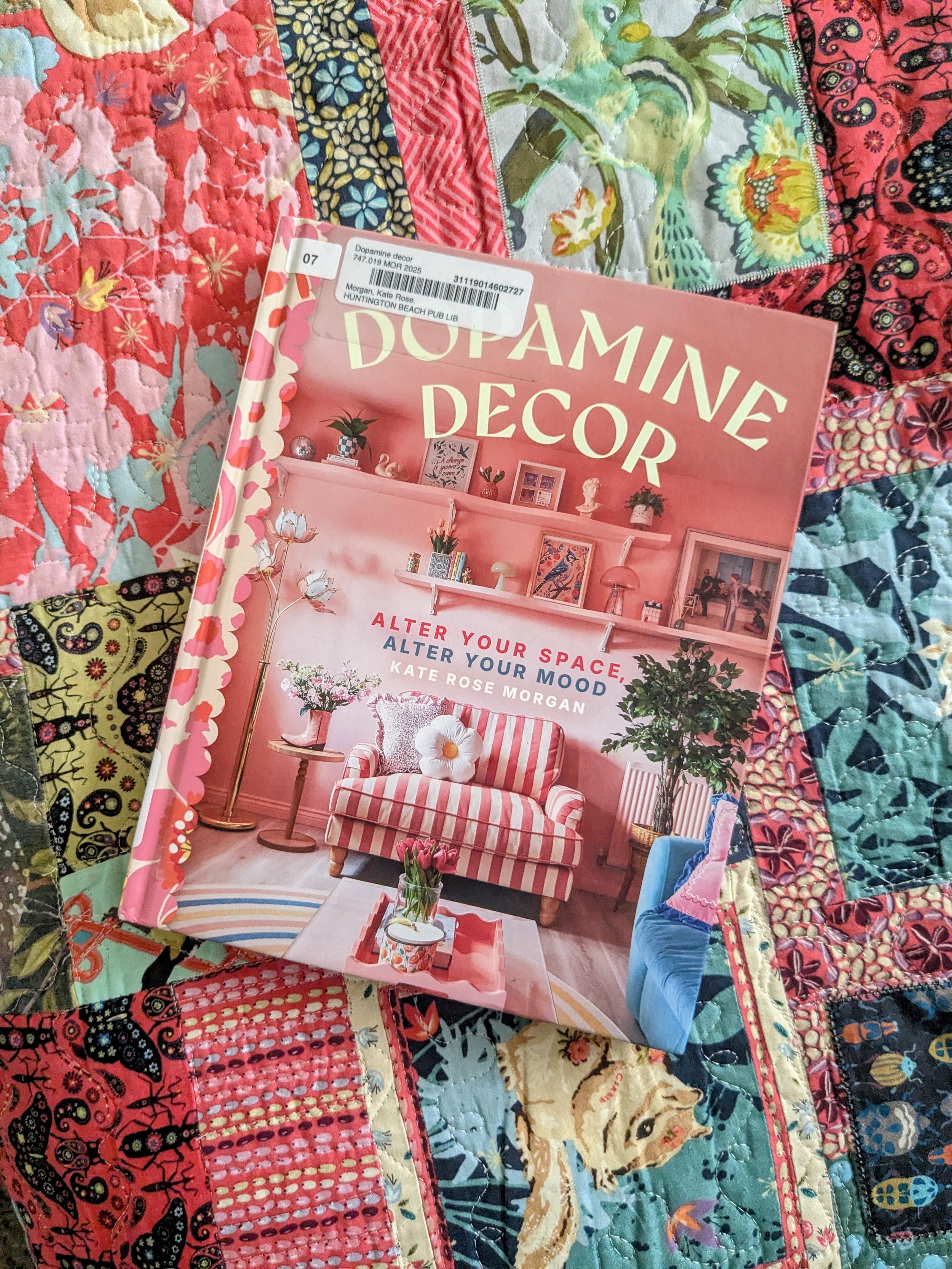
Sometimes you read a book and it fills you with so much passion, such an overflow of thoughts and words, that you send fifteen-minute video messages to your cousin, you leave dramatic-sounding texts on other friends’ phones, dramatic-sounding book reviews, and write a dramatic-sounding article.
“Dramatic – having or showing a tendency to behave or react in an exaggerated way.”
Okay, so maybe not dramatic…intense. I am not exaggerating when I say this book, Dopamine Décor, got inside my head, became the majority of what I thought about for days, and quite literally changed the way my brain was working at the time. And I don’t mind being intense about this book, when it was intense itself. Not just in the author’s aggressive, sometimes blinding use of color, but intense in the depth of insight Kate Rose Morgan brought to a simple subject: color.
Whenever I go to the library, I check the new arrivals shelf, especially the home décor section (Dewey decimal 747 for inquiring minds who want to know). Last time I did so, I came home with this absolute gem. I judged this book by its title and not its cover; and good thing too, because I kind of hate the color pink…at least in this book’s dramatic-overdose levels. I’m not going to lie; Morgan’s house is primarily various shades of bright migraine-inducing pink. Not my thing at all. But it just happened to be the right book at the right time.
For Context…
Since I was sixteen or so, I’ve been in love with a painting, usually presented as a diptych, a pair of paintings, titled Cigar Bar by Brent Lynch. It’s quite a departure from my usual aesthetic, and I have no explanation for my love of this piece. But maybe love of something beautiful doesn’t need an explanation. You just love it. In one painting, a man in an old-fashioned suit and fedora sits at the bar with his back to the viewer, holding a martini glass in his left hand, silhouetted in stark relief against an orange-red bar peppered with liquor bottles. He holds a cigar in his right hand and leans subtly, almost imperceptibly, with his head turned towards the next painting, where a young woman stands. She’s dressed in a classic, strappy black evening dress, her short retro-style hair is tucked behind her ear, showing a single pearl earring. A shawl drapes over her right wrist as she turns towards the man on her left and raises her own martini glass toward him.
I finally acquired prints of this painting at a thrift store, in a saga that could warrant its own article. But long story short, they’re mine.
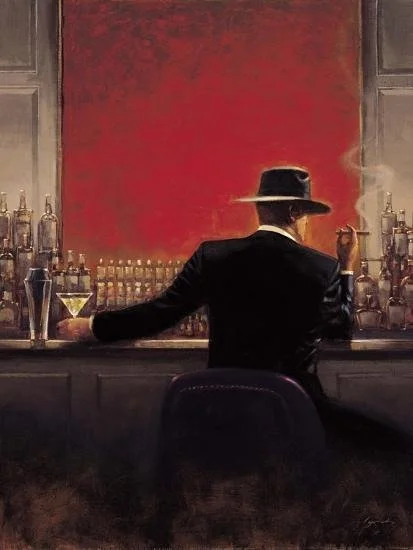
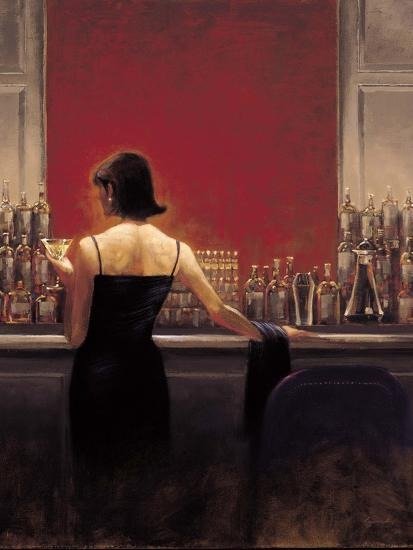
With one problem. The only place to hang them is over a blue couch I dislike, and I hate red and blue together. Also, I incline towards an older, less glam, more rustic, vintage aesthetic, and you can only pick one style aesthetic…right?...right? Add to that my husband’s aesthetic is even more starkly different (psychedelic), and as happy and excited as I was, I was also concerned I had just opened a can of worms at the bottom of which I’d find a large serving of Buyer’s Remorse.
While mulling this over and staring at the paintings on my wall, wondering if I should just wrap them up for Someday Later, when I don’t have a blue couch, when I can actually paint my walls, when I have more space to demarcate our various aesthetics, my neighbor popped over. My husband and I showed him the art and told him what we were discussing. He mentioned that they looked Art Deco to him. I told him I like Art Nouveau better than Art Deco and wasn’t quite sure how that could be brought in, let alone go with my husband’s favorite styles. The neighbor casually mentioned that Art Nouveau was the stylistic forerunner of the psychedelic and “trippy” art of the 60s and 70s. “Just look at the posters of the time,” he said. And then went on his way, leaving me standing in my living room with my brain bursting, and smoke coming out of my ears. (Okay, maybe that is a little dramatic, but let me have this one.) It started a mindset shift with one internalized thought…maybe all the different styles and eras and aesthetics out there weren’t as unrelated and disjointed as I thought.
Back to the Book
Dopamine Décor, in the meantime, was sitting, barely started, on my nightstand, but now it seemed important. I wasn’t sure how to make the various styles work together, but I had discovered I didn’t hate the orange-red paintings over my dark blue couch as much as I expected. Maybe if I understood color theory better, I’d understand why or even how to push them further from red tones into the orange tones they definitely carry.
I like pretty things, and this has taken me far in my decorating. But in general, I’m interior design-and color theory-illiterate. This is not modesty. This is the truth. My best strategy is going on Pinterest, saying “ooh! I like that!” over and over, and then hoping I find some pretty cousins of what I saw at the thrift store. Again, it’s gotten me far enough, but it’s time for some help in understanding things more clearly, in the interest of cohesiveness.
Morgan’s book began simply enough: with promises to teach you about color, and to help you identify your own personal colors. She calls them “comfort colors,” and by this, she just means the colors that make you happiest. Her advice takes the reader through analysis of favorite TV shows and movies, books and stories, vacations and travels, coffee shops and stores…basically thinking hard about every place you’ve loved to look at or felt strong feelings of happiness and positivity towards. She also encouraged looking through your closet and thinking about what colors you love to fill it with and what you feel fabulous wearing. This was where I started to pay more attention.
Where it got very interesting to me was in her next section on unleashing your inner child.
“Even in adult life, I can look back on parts of my childhood and they still make me smile, reminding me of that innocent sense of wonder I had as a child. I think it's really important for everyone to bring their inner child out when they are decorating their home...
Children always ask, "what is your favorite color?" It's almost like they can't wait to tell you what their favorite color is and it's their little conversation starter. My youngest, Olina, loves this question and she always likes to tell me her favorite color is blue. When they share their favorite color, I feel like it's them telling you a little bit about themselves and their personality.
As children, we naturally recognize how important color is to our lives. We know certain colors make us feel happy. We want those colors to be part of our identity, who we are and even how we want to be perceived. We design our birthday parties around our favorite color, and we dress in it from head to toe. When I was buying sneakers for Olina recently, she begged me for the ones that had blue detail on them – it was important to her. They felt right to her. She felt good in them. And that's the power of color; it does things to our emotions.”
She goes on to talk about how, “as we get older, we start to get new identities, we have to wear uniforms or have dress codes at work,” and in short, we begin to slowly have the color drained from our lives. Some of us who struggle with trend-suggestibility even start to like things just because we’re told we should. (My words, not hers.) So many times I’ve heard people say they avoided certain paint schemes or décor styles for no other reason than because it could detract from the saleability of their house…even though they had no immediate intentions of selling it. This has begotten the popularity of minimalist color schemes, millennial gray, beige, greige, and white-everything.
Morgan is the least judgmental design writer I’ve read so far, even with her passion for color. A few times, she says that if neutrals and white make you happy and fill your soul with joy, by all means, do that. Her point is simply to encourage you to identify what actually makes you happy and to pursue it full-tilt without shame. Your home should be a place of joy and comfort for you and your family, not a monument to what popular trends tell you that you should do.
“The more I think about it, the weirder it is that as adults we don't proudly wear and live with our favorite colors. I mean, why can't I be taken seriously wearing my favorite pink? Why do we have to grow up and lose our love of vibrancy? Why does the color have to disappear? It's like we lose touch with who we once were as children and the things we loved. And now we are here in adulthood, navigating life stresses, trying to find ourselves again without our favorite colors to boost us and help us through.”
This led to her primary questions to ask yourself. What is your favorite color? Go with it. What were your favorite colors and style loves as a child? Maybe there’s some “wisdom” to be found there.
And this period of introspection is where my head began to explode. Quietly. But the fuse was lit.
My Color History: A Retrospective
The first time I got to paint my bedroom, I painted it a medium shade of purple with spring green accents.
The second time I got to paint my bedroom, it was a creamsicle orange with dark grape-purple accents.
The third time I got to paint my bedroom (as an adult this time), I wanted it to be yellow, but bright colors were frowned upon in trends at the time, so I toned it down to a nice butter and paired it with a warm, slightly rosy taupe. I loved it, but I wish I had done the brighter one I actually craved.
Okay, I had my answers to her questions. Let’s keep reading. The second section of the book was the meat-and-potatoes of color theory. She laid out the color wheel and explained basic terminology (complementary colors, the ones directly opposite each other; and analogous colors, the ones next to each other), and then dove into her preferred color-choosing method of color couples and triads. She talked about starting with a Main Character color, adding a Supporting Actress, and then wrapping it all together with a Sidekick for finishing touches (often a metallic could be this last, missing piece).
The photos she used to show these concepts, while not my colors, were enlightening. A pink bathroom, with green accents in the shower curtain and art, and a small pop of lilac here and there. A lilac hall with a little blue, and a splash of green. A pink living room with a teal couch and mustard accents. Not my colors, but wow, did I respect what she was showing, and I could begin to see how to embrace it for myself.
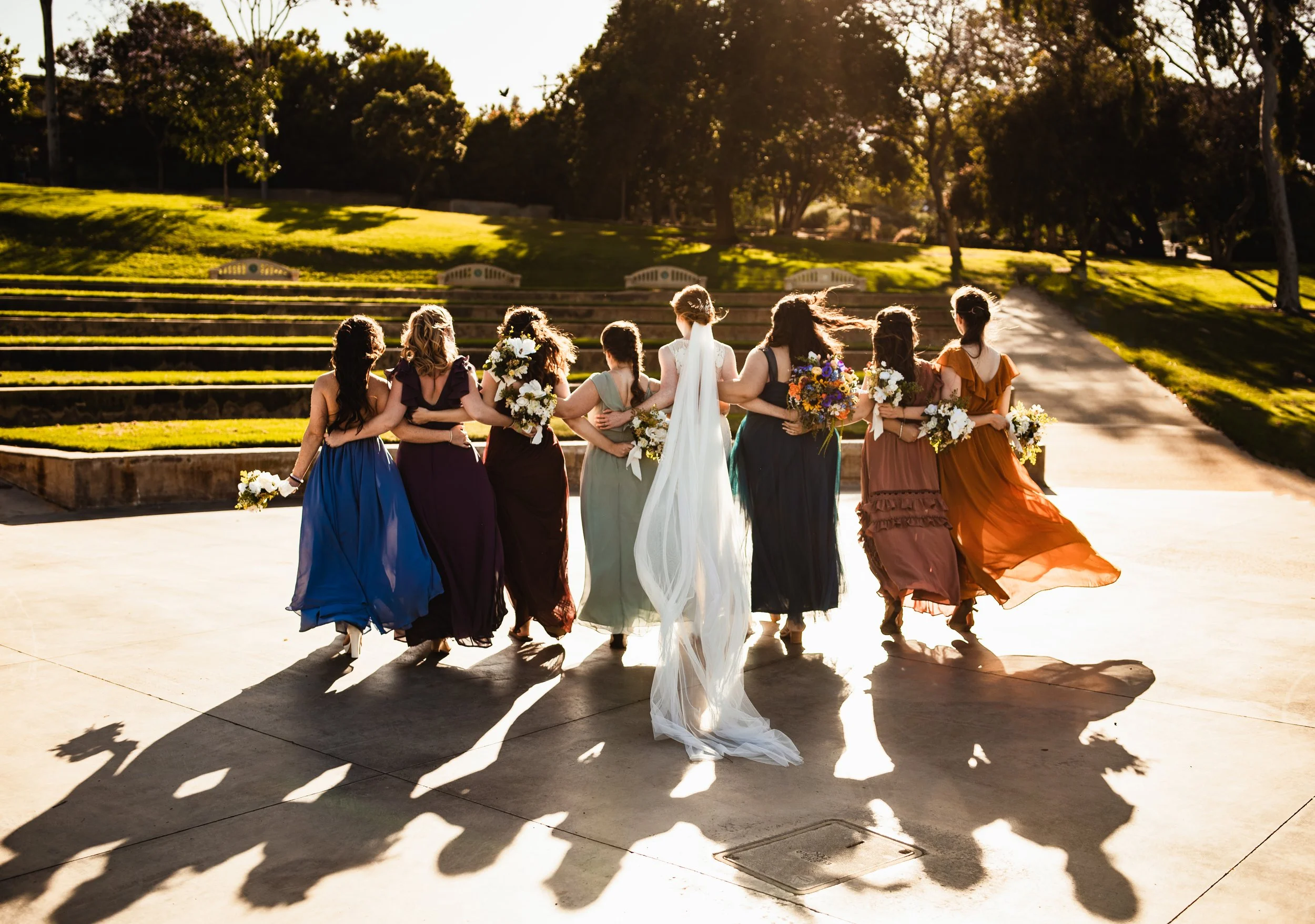
As I browsed through her color palettes and example photos, my whole life started to make sense. The bedroom colors I picked were just the beginning. When my husband and I were married, I had a hard time picking our wedding colors…so I kind of…just didn’t. I had leftover teal table runners from a friend's wedding, blue, green, purple, and clear glassware for the tables, a multicolor wildflower-inspired bouquet, and I allowed all my bridesmaids to pick their own color of dress – seven bridesmaids, seven different colors – with my only stipulation being that they be jewel tones or dusty. They coordinated this perfectly, and it ended up being my favorite decision from our wedding; every time I look at our photos I’m filled with joy.

In the last couple of years, as I’ve paid attention to what outfits or pieces of clothing make me the happiest, they’ve been the most colorful…olive green pants with a lavender top and mustard sweater; embroidered jeans with a yellow tee shirt and burgundy cardigan; pumpkin, emerald, and purple; yellow shoes with everything (even a pair of leopard sandals, *gasp*). I’ve been slowly taking our bedroom towards emerald and purple.
As my mind scanned various memories, I began to notice patterns and feelings in retrospect. Color couples, color triads, tone blending, spicy pops everywhere.
And I started to realize one of the reasons why I’ve disliked our blue couch is because I’ve allowed it to limit me to the point that there’s now very little color in our living room…just blue and gray, with some orange in one wall hanging.
All these things – my neighbor’s words, this new book, my color history, my current living room quandary – coalesced in my head, and I felt like the world made sense for the first time. I made sense for the first time. I dove into Pinterest like a parched desert wanderer diving into a cool oasis, bathing myself in color palettes and ideas.
The Final Piece
“I just love the weird and wonderful. I love how a pop art print looks next to a vintage oil painting. I think it adds contrast and interest while keeping it fun. But the main thing is to keep the color scheme of your room flowing through the pieces of art…You will not get the exact same shade for every piece, and that’s fine, but once on the wall with all of the others I promise it will feel like it all matches.”
As I’ve browsed various design and style aesthetics, I’ve been so confused by which labeled box to contain myself in. Cottagecore, ghiblicore, vintage homestead, gothic farmhouse, whimsigoth…all of these had things I loved and was drawn to. Some were too neutral, some too dark, all not exactly me. How to blend all the things that are me? All the things that are us, as my husband and I fuse and blend to create a family style? This book helped me begin finding the answer. The one thing my husband and I are both passionate about is also the key to fusing our varied tastes. Color. We both love color. We both knew this, but I didn’t KNOW it in a truly internalized way that affected my actions, in a fully conscious way. It feels like everything suddenly opened up into wide vistas of beauty.
Now I looked at my living room, my orange-red-toned paintings, my dark blue couch, and I started to see the potential, the palettes that could work. Different shades of blue to play with, a burnt orange blanket to bring in, the orange and blue tapestry that had previously been on the wall, now used as a table drape – things are gradually pulling together some kind of look. A look I don’t need to name, label, or hashtag to validate. It isn’t cottagecore, grannycore, midcentury modern…it simply is. And it works because it’s based on objective principles of how color works and subjective feelings of love and enjoyment.
And my mind is racing with future plans involving teal and molding and chair rail and…who knows? Where once I felt restricted and limited, the options now feel endless. I’m saving color swatches and ideas for the future to Pinterest boards, because, as inspired as I am, I have no intention of painting my apartment at this late stage of the game. This is my research and information-gathering stage. My feeling is that if I can frontload the mental work now, study, learn, and envision, then when we move (in the hopefully near future – pray for us, sisters), I will be able to enter the action phase more quickly and smoothly.
Since reading this book, I notice color everywhere. I see palettes in my closet, at the store, in nature, in my kitchen. I read palettes in a science fiction novel in the description of a planet; in The Hobbit as he describes Bilbo’s outfit or the dwarves’ cloaks. Colors dance in my head in pairs and triads. I file them away and look for new ones. Creativity has begotten creativity, as my fingers itch to get out my watercolors and just swirl colors together to see how they look. Maybe I should try to paint that planet-scape, I think to myself. I feel so hungry and so satisfied at the same time. So stimulated, excited, and at peace simultaneously. I can quite literally feel my brain working differently, like new neuropathways were formed just by this particular “click”.
This is why I read. This is why I read home décor books, even though I can’t enact too much right now. This is why I pick up books with covers that scream, rather than beige-ly whisper, even if their exact taste isn’t mine. Because sometimes a book changes your life, shapes your brain in new ways, and makes the world a little brighter.
Would this book have the same effect on every reader? Likely not. But if you’re color-retarded like me, it might just help.
Thank you for this wonderful and inspiring book review!