The Christian Community and the Homemaker
I’m filing this article under personal articles, not because it isn’t about homemaking like some of them here, but because it is less applicable to the non-Christian homemaker. I still think a non-Christian homemaker could profit from this article like I profit from many non-Christian articles, but because it is more faith and theology, I think it belongs here.
My church has been watching a Sinclair Ferguson video series—“The Basics of the Christian Life”. In one of the episodes, Ferguson said that it seems like we’re past the era of personal evangelism because the response to an expression of faith is great, glad that works for you. He said that he thinks the real witness of the power of the gospel is going to be in our church community.
I have been chewing on that thought for several weeks now because it excited me. It excites me far more than the idea of trying to bumble my way through the gospel, red faced, with a total stranger who is probably having about as much of an awkward time as I am, and don’t get me started on the horror of door-to-door witnessing. If you would like to 100% guarantee that I will not be buying what you’re selling, “cold call” me by knocking on my front door or approaching me in the driveway. So why have I spent so much time with this thought and why does it excite me? Because as a homemaker, community is my wheelhouse. As homemakers, community is our wheelhouse.
Our culture is cut off from community in part due to our indulgence in the found family—we haven’t worked on the relationships with our actual families and have discovered our found families less than fulfilling and just as much work. Friends, How I Met Your Mother, and other sitcoms lied to us—as have cancel culture, and our indulgence in social media. While there are times we need to shut the door on people, we tend to do this far too quickly. Being friends is disagreeing while still loving and still working together. We are still feeling the lingering effects of 2020, when we gave up human interaction for online interaction, which simply isn't as fulfilling as a real community with real people. Social media feels like it is giving us community, when in reality it is quietly and subtly destroying it one minute wasted doomscrolling at a time.
Side Note: I’m not saying don’t use social media to wind down, rest, or do research. I’m saying don’t allow the friends in your phone to become your only friends…which is much easier to slip into than we think it will be because they’re so much easier to deal with than real friends who cost us.
But what do we have in the local church? In our church membership, the vows we have made to one another, in our unity as one body? Community. We have real love in real communities really worked out for the long haul. We have people living and working together. We have accountability and encouragement. We have conversation, brotherhood, and belonging. We have diversity in race, income, gifts, and interests. And we’re realistic about the work involved in living in community. We seek reconciliation and peace, but that requires an acknowledgement that there will be estrangement and hostility. Not if, only when. But because we’ve made vows to one another, we work it out.
The church community is a place to practice faith, hope, and love. The people around us get to benefit from the fruit the Spirit is producing in us through our feeding on the means of grace. When we feed on the preaching, prayer, baptism, and Lord’s Supper, the Spirit produces fruit in us to share with others—love, joy, peace, patience, kindness, goodness, faithfulness, gentleness, and self-control. That fruit isn’t just hanging there on our metaphorical branches, wasted, rotted, and spoiling. Fruit is meant to be baked into pies, turned into jelly and jams, sliced into fruit salads. Fruit is meant to be shared. This is the essence of community.
Community requires practice and effort. It requires people to make meals, open doors, communicate. It requires managing schedules, hosting get-togethers, managing facilities, seeing needs and handling them. Community requires seeing the helpers and thanking them. It requires hugs and conversations. It requires a heart to serve before being served. It requires each of us to guard and garden our hearts for the sake of the friend beside us. Why looky here! Community requires all the things home requires, which means we, the Christian homemakers, have a wonderful witnessing opportunity by simply doing what we do. Ladies, this is what we’re trained, or training, for! We are constantly engaged in educating ourselves, in practicing, in growing our skills and expanding our skills in all these areas.
We can pour all the mothering (positive nurturing and nourishment) that is part of our body and soul into our churches (both people and buildings). Food, clothing, and shelter are our profession. This is what builds a community that calls those in the darkness to step into the light. Just like we light the way back home with a candle in the window to guide our people back to us, so we can work quietly in our churches and do the same thing.
How do we go about this, practically? What is your favorite part of homemaking? Take that and apply it to the church!

Are you a thrifter or bargain hunter? Ask around for needs. Maybe there are some young families that could use extra things, or maybe the building needs new furniture. Maybe the nursery could use some new toys, puzzles, or books. Find out what shut-ins or those with chronic health issue have on their wish list and keep an eye out for them. Do you love cooking? Maybe the quiet bachelor could use some cookies. Or that harried mom a breakfast. Do you love gardening? Ask a deacon who is struggling financially and share your produce with them, or even simply share your seeds. Social butterflies can be a huge blessing by visiting widows and shut ins, having moms over or even babysitting. Extroverts can meet and greet visitors and introduce them to the shy or wary. Introverts can people watch, note others’ quiet service, and then write a thank you card. Researchers can share what they’ve learned or help someone learn something. Take what you love and share it with your church.
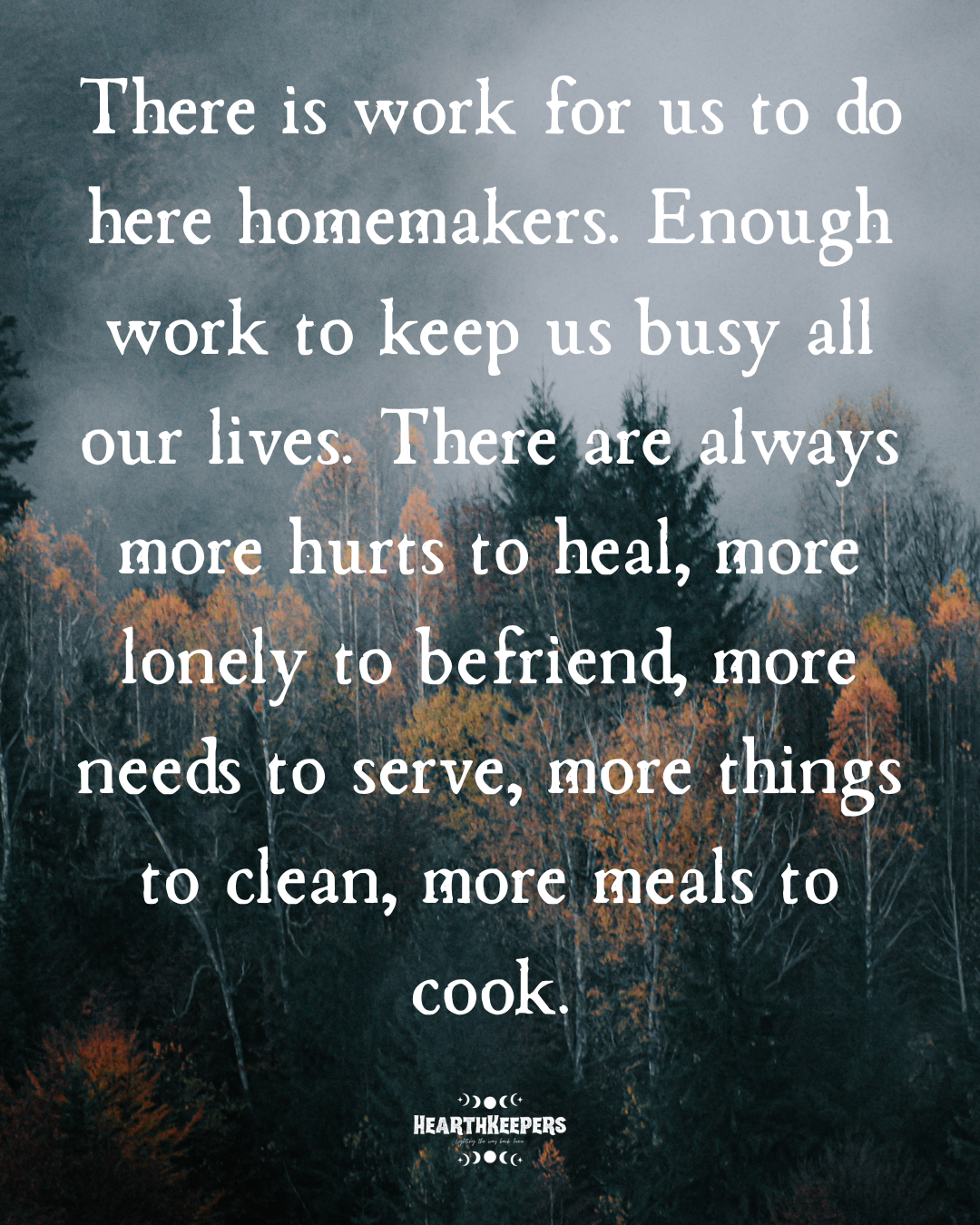
How is this different? How is a Christian community different than other communities? What will draw those lost in the darkness in? We’re more than just practicing prudence, justice, temperance, and courage. We are adding to that the Fruit of the Spirit. What the world will, Lord willing, see is people not cancelling each other due to hurt feelings or disagreements. What the world will see, Lord willing, is a real found family of misfits actually sticking it out through life, suffering, and struggles. What the world will see, Lord willing, is people not living with a social media filter, but bearing real burdens and celebrating real joys. Lord willing, the world will see a place truly united by our love for our Lord, across race, gender, and culture. There is work for us to do here homemakers. Enough work to keep us busy all our lives. There are always more hurts to heal, more lonely to befriend, more needs to serve, more things to clean, more meals to cook. We don’t need to scream on the street corners or on social media—we simply need to take what we do every day and do it every day for our people and our churches (both buildings and people). This will be a beautiful witness to the dying world that there is life!
9 Let a widow be enrolled if she is not less than sixty years of age, having been the wife of one husband, 10 and having a reputation for good works: if she has brought up children, has shown hospitality, has washed the feet of the saints, has cared for the afflicted, and has devoted herself to every good work. – 1 Timothy 5: 9-10 (emphasis added)

Click on the image to join our community, our knitting circle.

Click on the image to learn more about this gritty HearthKeeper story.

Thank you for the wonderful editing, Sarah!