Writing in a Circle, or Why It Helps to Have a Co-Writer

I have a natural tendency to write linearly. Here is a straight line, let’s follow it. I tend to write like I’m looking at a timeline tacked to the classroom wall. A to B to C and so on. I used to write every character, location, and event in this fashion. And it worked. It wasn’t a bad way to tell a story. It got me from the beginning of a tale to the end of the tale many times. It just wasn’t the most satisfying way to construct the lives and events of characters, especially as a writer with limited time and energy. (This isn’t my career, and I have some chronic fatigue struggles.)
Enter Alana.
As we worked on Stoneheart, she mentioned in passing the idea of circling back.
My brain exploded.
If memory serves, we needed a location for a scene. I racked my brain for a new town or city with an appropriate name to set it in. I thought linearly. We had this city, this town, this town, this ranch, and this cottage, so we needed a new location for this new moment. Alana suggested we use one of the locations already in the book, that we circle back, tie places and people back in so that the story is more of a circle and less of a line. What!? I can do that? (We writers can be so blind to what is right in front of us.)
Later, we needed a scene for Psyche that showed the emotional struggles she’s wrestling with regarding guns. We needed a small antagonist for this scene. It didn’t need to be anyone important. It wasn’t a main character, a side character, or even a repeating background character. This scene was about Psyche. Alana racked her brain for this new character, knowing he needed enough skeletal structure to not just be a scarecrow. I suggested we circle back to a character from the beginning of the book. (I’d already learned my lesson well.) Alana hesitated. I reminded her of what she told me about circling. We agreed! Pulling Chester out of the mass grave at the start of the book gave us some interesting moral issues for our characters to spar with, but having Chester appear in the woods on a snowy day, more broken by mercy than healed by it, threatening Psyche and Rune was far more interesting than a new character.
Circling layers a story.
Bringing Chester from near the start to near the end gave our story more resonance. It was satisfying. It allowed us to finish his story and layer continuity into the overall plot.
Circling enriches a story.
When you have a good wine, whiskey, cigar, meal, or dessert, the first flavors to hit your tongue are important, but the richness comes from the flavors that follow. A well-informed sommelier will guide you through these different levels of taste as he pours your wine. A rich bourbon will taste of far more than simply an alcohol burn, and each bourbon will have its own complex layers depending on how it was made. A well-told story is much the same. The first layer is the characters and plot. Who is in the story and what are they doing? More layering is what makes a book enjoyable to re-read or a show to re-watch. We return to the story to see how things are hinted at from the beginning, to see more of the world-building, and to notice all the little details that the writers sprinkled into the path of the characters, and thus the readers. This happens in the layering, and circling back is where some of those layers come from.
Circle back, writers, circle back.
I took this tool into our new book, Wizard Prison. About 50,000 words into the first draft, the cast list was getting a little clunky. There were too many people doing too many things for this busy homemaker to keep up with as she did the dishes and swept the floor and ironed shirts. Parth is our main character. He has five important side characters helixing around him—Adam, Kaizoku, Jael, Ross, and Cid. Then I have our behind-the-scenes political villain, our monsters, a covert operative, and the villain the reader knows, Algernon. Between the six heroes and the three villains plus monsters, my head got quite loud! I needed to turn down the volume. I had my phone read the so-far draft to me while I went about my chores. Algernon spoke up. There was no reason for him to be a psychotic-limp-wristed character. If I combined him with the covert operative, he would not only be more intimidating, but it would remove an unnecessary middleman. Done and done.
But what about circling?
In our world, there are three influential families in charge of the Department of Thaumaturgy (DOT) who make up the majority of the Executioner Officers (EO), which are both the police force and the actual executioners of criminals. EOs aren’t exactly beloved by the citizens. Over the generations, they’ve mapped out their family trees and married into only minor and major branches. Jael is an EO from one of these families, but she’s committed the one great EO taboo: she divorced her husband. He’s from another of the big three families. Since all marriages are consolidations of power and made for political reasons, Jael’s divorce cost her whole family some of their political standing within the DOT and with the other two families. It also ruined her socially and guaranteed her she would never be promoted. Jael’s great-aunt, Commissioner of the EOs, is determined to use Jael one way or the other to regain and strengthen her position of power.
All of that is worldbuilding, background, and backdrop for Jael and the Wizard Prison. I’m not a political-intrigue writer or reader. Nothing bores me more. Real life has enough politics. I don’t need it in my imaginary world. But! Back to circling. Here I am, making beds and doing dishes with Algernon telling me what kind of villain he wants to be—look at him being all helpful—when he whispers, “I’m Jael’s ex-husband.”
What?
“I’m Jael’s ex-husband.”
The ex-husband’s not important. He’s purely background so I can figure out Jael as a character.
“I’m Jael’s ex-husband.”
You’re an insistent little twirp, but…
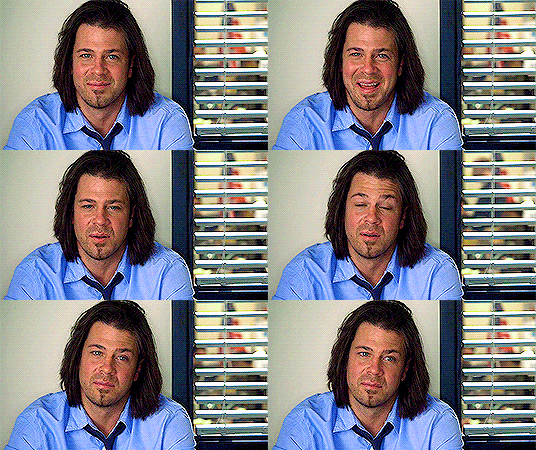
I started considering. I considered how this would impact the political culture I’d already established, how I’d have to redo my villain timeline, and what this would mean for the other villains, and I realized that I’d have to keep Jael from seeing Algernon as long as possible. Everything checked out. It deepened the political culture, made my background villain more villainous, made Algernon (now smugly smiling) a mentally stronger and smarter villain, made sense for the situation with the three families, and gave me a way to make Jael’s background important.
It brought the story full circle.
It layered the story.
It enriched all the characters and the worldbuilding. It gave me plot points to aim for. It answered questions in my mind. And it shortened the cast list while fleshing out the villain's actions.
I was so happy! Algernon has gone from a whiny, annoying, and creepy man to a competent, dangerous, and slightly creepy man. He’s so much better. The story is stronger. Jael’s future is going to be more impactful. The culture is fuller. Everything slipped into place.
I’m so happy!
Circle, dear writers, circle.

Available on Amazon. Click the image.