The Oddity of the Inner Life of the Author: Post-Publishing Discoveries
(Spoiler Warning for Stoneheart.)

Photo by Kate Laine on Unsplash
One of the weirdest elements of being a writer is how separate from yourself your own stories can be. This is why the analogy of parent/child works so well. Our children are ours and not ours at the same time. When a story is read by others or published, it takes on a life of its own away from the original writer. The really strange part is when it comes back to the writer with things previously unseen. An applicability appears that was never part of the original process or intention. All good stories do this, have this ever-broadening applicability, but it is a bit odd to stumble upon it with your own book.
I’ve had people see unintended depth in my stories before. An early reader of Stoneheart pointed out to me how much they loved the alchemical use of red, white, and black over and over and over in the story. I was tempted to sagely nod as if I had done this on purpose, as if I were that clever. Nope, sorry, I was just trying to atmospherically signify the Snow White roots of the story, and that seemed like a good way to do it. See, my muse is like a rather messy apothecary with my current WIPs simmering in cauldrons clustered together in the corner. The Woven Throne (possible title) is the front and center cauldron, merrily bubbling away and hopefully getting closer for my co-author to start taste-testing. Nearby is my HearthKeeper cauldron, filled with the studies of home and homemaking. I dip regularly into this cauldron. Hanging from rafters, stuffed in mislabeled drawers, filling shelves of glass jars, going cold in forgotten mugs, poking out of vases, and collected in bowls are all the things I love: military history, family, nature, Tolkien, Lewis, theology, coffee, trees, chickens, children, warriors, fairy tales, Vikings, cowboys, home, and more. Because this inner apothecary is so unorganized, things tumble into my cauldrons that I didn’t necessarily intend or even notice. My homemaking boils over into The Woven Throne, making a cottage a cozy respite. A bit of military history drops into my HearthKeeping cauldron and changes the flavor of my group. (Sorry, ladies! Yes, I’m talking about Navy SEALS again.) Something I don’t even remember knowing I know gets stirred in until it’s perfectly blended. The soups and tonics that pour forth from this delightful chaos are impossible to explain or repeat. Typically, I can tell you the initial inspiration—Snow White for Stoneheart and Snow-White and Rose-Red for The Woven Throne—but after that, all bets are off. Trying to figure out where this or that piece of the story came from originally is, thankfully, impossible.
What this does is create a situation where an author can look back at their own published works almost as a reader and bring them into their larger literary conversation, because if you are a reader, you’re engaged in a literary conversation with yourself all the time. Now a caveat; I can’t speak to the conversation potential of much of what is published right now. I don’t read celebrity biographies, and I don’t read modern women’s fiction unless forced to, and there will be kicking and screaming. My junk reads tend to be more in the Louis L’Amour, Larry Correia, or Bernard Cornwell vein than anything filling most of the shelves today, so when I say literary conversation, I typically mean that I read this book about Easy Company and something said there reminded me of this moment in a favorite movie that is an excellent illustration for this theological truth, which made me think of something in Lord of the Rings or Jonathan Strange and Mr Norrell, but then this bit of philosophy over here ties into what was said here, and all of the sudden That Hideous Strength made a bit more sense…don’t peck my book, Astrid. No, Skađi, you can’t have my pen. No, Sif, I don’t have snacks. (Have I mentioned my brain is a messy apothecary and that I tend to read outside with my chickens?)
Now, I’ve had the exciting and wonderful privilege of reading something in one book and my own book, Stoneheart, jumping in on the conversation. This isn’t something I can take credit for; it’s just part of what’s in my apothecary.
I am reading—as everyone knows because it is all I’m really talking about—Planet Narnia by Michael Ward. Because it is an academic work, it’s just a bit of a stretch for me to read. Not a big stretch, just a little one, a good one, like pushing yourself in a workout or yardwork. Yeah, you’ll be tired, but it’s a satisfying tired. My goal this year was to do more stretching and slow my reading rate down so I could better retain what I was reading. As I’m reading Planet Narnia, I’m reading Lewis’ poem Planets regularly, I reread The Space Trilogy, and I’m rereading the Narniad. I’m also reading each chapter twice. Once to outline and get the big picture, the second to take notes, write down lines, and add notes to my copies of The Space Trilogy and the Narniad. I’m loving it! (Also, all you lovely substackers have given me the longest Lewis reading list to add to my already ridiculously long Tolkien reading list. Thanks for that.) I just got to chapter 4: Mars. As someone who loves modern military history (boots on the ground memoirs, not politics) and who has written warriors since almost the beginning of my writing life, and who loves to note how Lewis and Tolkien deal with warriors, I was excited about this chapter. I trusted this chapter. I am often on guard when warriors are being dealt with because they’re so often thrown under the bus as useless, violent barbarians, baby-killers. (My beloved FIL fought in Vietnam. I tend to be defensive.) But because I’ve read Lewis and about Lewis, I came to this chapter ready to hear him explain the cosmology of this warrior planet, expecting inspiration, not condemnation. My faith was 100% justified. By the end of the chapter, my brain was on fire with all my favorite warriors.
One of the things Ward points out that Lewis wrestled with is the ‘evil’ of Mars in a cosmology of perfection beyond the moon.
“Lewis knows that Mars is a bad planet, Infortuna Minor, and so he readily acknowledges Martial cruelty, trouble, haughtiness, gracelessness, mercenariness, insolence, coldness…And so we find listed alongside many Martial vices, many Martial virtues: righting wrongs, rescuing the meek, laughter, beauty, keenness, blitheness, happiness, achievement, courage, strength…Mars is not necessarily evil; rather his spirit which, used aright, enables hard but necessary tasks to be accomplished.”
As I read through this chapter, I thought of the perfect illustration for this: George Sullivan. Sul is our bountyhunter with a stone heart. He is all that is bad about Mars. He is only all that is bad about Mars. Sul is cold and graceless. His whole life is about filling the next bounty, and he’s good at his job because he is relentless and uncaring. This man, crammed with unfeeling Martial vices, makes a choice for life that even he doesn’t really understand. (In a way, our book starts with an eucatastrophe.) This changes his life and allows the Martial virtues to begin influencing him. His stone heart is broken, and real strength and courage pour in.
Was it my intention to write a character that went on a Martial Journey? Not at all. But it’s also not a huge shock of red in an otherwise green room. I’ve made it my life’s work to study warriors, and I’m well aware of the horror an out-of-control, purposeless warrior can bring to himself and those around him. I’m also well aware of the good a warrior can accomplish, of their necessity and their heroism. I’m familiar with Mars without knowing I’m familiar with Mars beyond knowing he’s the god of war in Greek, Roman, and Norse myth and now medieval cosmology. So it’s not surprising, but it was pleasing to read this academic work and see an illustration of it in my own story, in Alana and my story. Sul has only allowed the negative Martial influences in his life, but by the end, the positive sides will be the greatest influence, bringing healing and a real, flesh-and-blood heart back to our bountyhunter. What an odd moment as a writer to realize something you didn’t plan tumbled into your cauldron and infused your story with another layer.
“Taken aright, Mars strengthens noble warriors and gives resolve to the martyr.” This is Sul, Sul as he moves from Sul to George, as he faces himself via a horrible choice, as he indeed ‘dies’ and is reborn a whole and good man.
Being an author is a strange thing. Sometimes a book returns to your side as a friend instead of as a child. Sometimes it joins the ranks of beloved stories as if someone else had penned it. Sometimes it joins the greater literary conversation, serving as inspiration and illustration of truth. What a weird moment. What a wonderful moment to get to see your stories grow up!
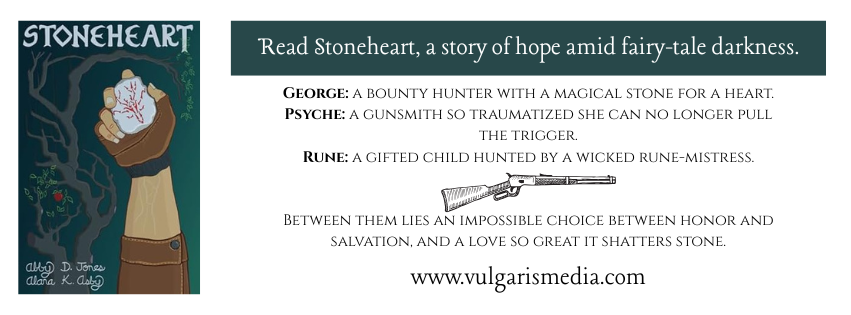
While we all wait for Wizard Prison to be finished, may I suggest checking out our debut novel? It is, shockingly, set in the winter.
Thank you, as always, for the edits!